Number of purchase orders processed per FTE that performs the process group "procure materials and services"

This measure calculates the total number of purchase orders processed per full-time equivalent employee (FTE) who performs the business activities of procurement planning, purchasing, sourcing, and inventory management. It is part of a set of Staff Productivity measures that help companies assess the efficiency of their staff related to the process "procure materials and services."

Benchmark Data

Lock

Sorry! Not all users have access to all our resources. If you are not logged into your APQC account, please log in and try accessing again

Not a member yet? Members have access to all of our resources.

Learn about Membership Arrow with stem

Measure Category:
Staff Productivity
Measure ID:
104129
Total Sample Size:
5,110 All Companies
Performers:
25th Median 75th
- 728.6 -
Key Performance Indicator:
Yes

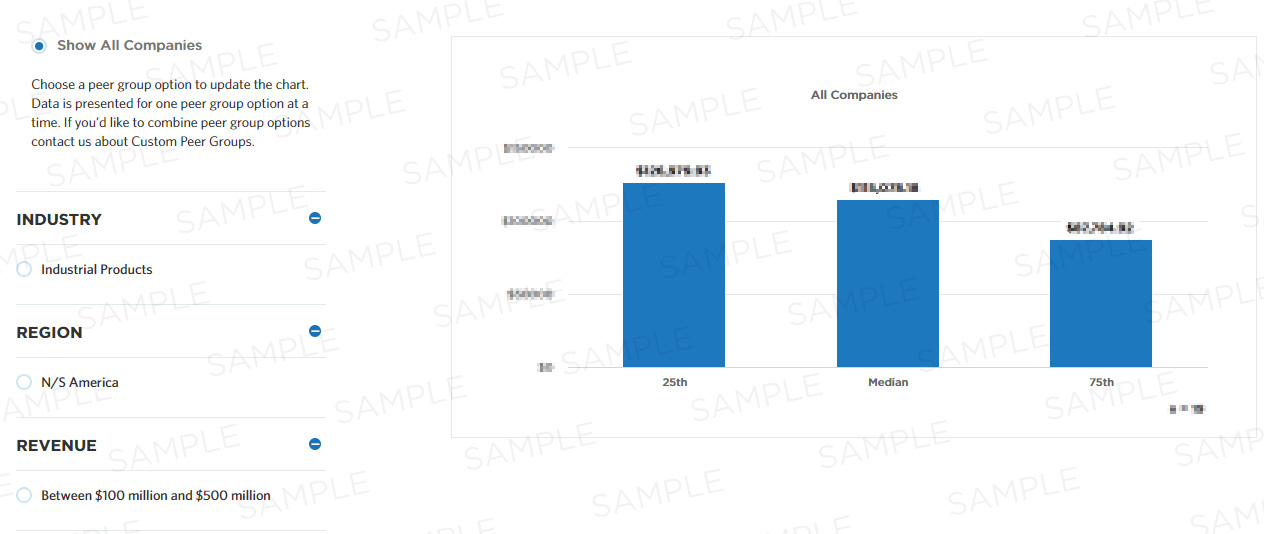
Sample image showing interactive filters for more detailed measure peer group data and an interactive graph.

Compute this Measure

Units for this measure are purchase orders.

Back to Top

Number of purchase orders placed / Number of FTEs who perform the process group "procure materials and services"

Key Terms

Back to Top

To calculate the number of full-time equivalents employed during the year for each respective process or activity, you must prorate the number of employees and the hours spent performing each process/activity. Assume that a full-time worker represents 40 hours per week. Provide the average number of full-time equivalents employed during the year for each respective process. Include full-time employees, part-time employees, and temporary workers hired during peak demand periods. Allocate only the portion of the employee's time that relates to or supports the activities identified for an applicable process. Prorate management and secretarial time by estimating the level of effort in support of each activity, by process.

For example, a part-time secretary in the finance department for XYZ, Inc. charges all of his time to finance department activities. He works 20 hours per week. The secretary splits his time evenly supporting employees working in the general accounting process and the financial reporting process. Thus, his time should be allocated by process. So, if he works throughout the year and supports these two processes, his time would be split evenly as:

20hrs/40hrs = .5FTE * 50% for general accounting = .25FTE for general accounting

20hrs/40hrs = .5FTE * 50% for financial reporting = .25FTE for financial reporting

Staff Productivity is a measure of the efficiency of individuals performing specific processes. Measures in staff productivity generally relate the transaction volume or outcome of the process with the effort in terms of full time equivalent employees to perform the process.

The metric value which represents the 50th percentile of a peer group. This could also be communicated as the metric value where half of the peer group sample shows lower performance than the expressed metric value or half of the peer group sample shows higher performance than the expressed metric value.

Measure Scope

Back to Top

Cross Industry (8.0)

  • 4.2.1 - Provide sourcing governance (10277) - Creating strategies for procuring materials and services from various sources, and for managing and evaluating categories. Establish a procurement process that describes the approach for obtaining products and purchasing activities. Evaluate the sources. Create sourcing relationships in order to continuously improve. Re-evaluate purchasing activities.
    • 4.2.1.1 - Develop procurement plan (10281) - Creating a plan for procuring materials and services. Plan what to buy, when, and from what sources. Include project requirements, the procurement team, the justification for the procurement, a timeline of events, and an explanation of the supplier selection process. Outline specific actions to start and complete purchases in order to adhere to best practices.
    • 4.2.1.2 - Clarify purchasing requirements (10282) - Defining the purchasing requirements for materials and services. Specify the exact inventory required for the production process. Create a specific quotation for all the sources in order to avoid any duplication or overlap.
    • 4.2.1.3 - Establish materials management contingency plans (10283) - Developing a strategy to deal with issues projected to arise during implementation of the inventory plan. Identify how to react to issues that arise and require changes to the inventory plan, such as a vendor failing to deliver materials on time. Collaborate with production and suppliers to prepare solutions to projected problems.
    • 4.2.1.4 - Match needs to supply capabilities (10284) - Synchronizing the requirements of materials and services and the capacity of suppliers for providing these materials and services. Revamp the procurement needs of the company in consideration of the capabilities of the suppliers.
    • 4.2.1.5 - Analyze organization’s spend profile (10285) - Evaluating the spend profile of the organization. Collect, cleanse, classify, and analyze the procurement data with the purpose of reducing procurement costs, improving efficiency, and monitoring compliance.
    • 4.2.1.6 - Seek opportunities to improve efficiency and value (10286) - Seeking the most efficient sourcing and procurement opportunities.
    • 4.2.1.7 - Collaborate with suppliers to align with long term business goals (21616) - Collaborating with the suppliers of materials and services in order to determine new opportunities for sourcing, share market insights, manage risk, identify and align supplier capabilities with long-term business goals.
    • 4.2.1.8 - Collaborate with suppliers to identify sourcing opportunities (10287) - Collaborating with the suppliers of materials and services in order to determine new opportunities for sourcing.
  • 4.2.2 - Develop category plan (16636) - Defining sourcing strategies and plans for categories of materials or services to optimize cost, supply continuity, value, and alignment with organizational requirements and market conditions.
    • 4.2.2.1 - Analyze category/product positioning and performance (11470) - Analyzing the position and performance of sourcing categories or products based on spend, supplier dynamics, market conditions, and value contribution to inform category planning decisions.
    • 4.2.2.2 - Forecast demand for each category by market (16637) - Forecasting demand for sourcing categories across relevant markets or consumption channels to support planning, supplier strategy, and capacity alignment.
    • 4.2.2.3 - Assign revenue and margin targets to each category (16638) - Establishing revenue, cost, and margin targets for sourcing categories to guide category strategy, sourcing decisions, and performance evaluation.
  • 4.2.3 - Select suppliers and develop/maintain contracts (10278) - Evaluating supplier options to select the most effective and efficient suppliers. Validate selected suppliers. Establish and manage supplier contracts.
    • 4.2.3.1 - Select suppliers (10288) - Evaluating the pros and cons of various suppliers. Choose the most appropriate and cost-effective suppliers on the basis of their material quality, delivery schedules, and costs.
    • 4.2.3.2 - Certify and validate suppliers (10289) - Validating the supply sources, and provide certification as an official supplier.
    • 4.2.3.3 - Negotiate and establish contracts (10290) - Legally binding suppliers with the company. Negotiate contracts individually with all the suppliers that include the promised material delivery, the delivery dates and duration, etc.
    • 4.2.3.4 - Manage contracts (10291) - Keeping contracts up-to-date with routine evaluation. Maintain order and discipline with the contracts in order to avoid any loss of information and mishaps.
  • 4.2.4 - Order materials and services (10279) - Creating and approving requisitions and distributing purchase orders accordingly. Hasten the procurement process to satisfy internal needs.
    • 4.2.4.1 - Process/Review requisitions (10292) - Handling operations related to processing/reviewing the requisitions. Establish and maintain procedures for the initiation, authorization, and processing of purchase requirements to procure products/services.
    • 4.2.4.2 - Approve requisitions (10293) - Approving requisitions for materials and services. Examine distributor-specific requests, and validate them individually.
    • 4.2.4.3 - Solicit supplier quotes (10294) - Requesting quotes from suppliers. Use a request for quotation (RFQ) to invite suppliers into a bidding process for specific products/services.
    • 4.2.4.4 - Create/Distribute purchase orders (10295) - Creating and placing the orders for purchasing materials and services from suppliers. Analyze vendor quotes. Choose the most cost-effective vendors. Create vendor-specific orders. Distribute them in order to initiate the purchasing process.
    • 4.2.4.5 - Expedite orders and satisfy inquiries (10296) - Accelerating the purchase orders in order to fulfill the internal needs (for raw materials) depicted through inquiries.
    • 4.2.4.6 - Reconcile purchase orders (10297) - Verify that purchase orders are filled as expected: verify that items and quantities are delivered as expected, based on purchase order details and goods receipts.
    • 4.2.4.7 - Research/Resolve order exceptions (10298) - Identifying and resolving any exceptions. Address the internal needs/inquiries for materials that cannot be procured immediately. Research inquiries that require the need of exceptional materials.
  • 4.2.5 - Manage suppliers (10280) - Collecting and analyzing new information in order to track and rate suppliers and build relationships.
    • 4.2.5.1 - Monitor/Manage supplier information (10299) - Create and maintain vendor master files. Examining procurement and vendor performance. Report delivery timing and the quality of the materials procured through different vendors. This data must align with vendor master file, see PCFID 10869.
    • 4.2.5.2 - Prepare/Analyze procurement and supplier performance (10300) - Assisting the production and inventory processes through the information and reports created. Use the information and metrics of the procurement and vendor performance to enhance or improve the production process.
    • 4.2.5.3 - Support inventory and production processes (10301) - Support inventory and production processes by analyzing impact of procurement decisions and collaborating to constantly improve. (For example, perhaps minimum order requirements could be negotiated to be lower, to reduce excessive inventory and make production more flexible.)
    • 4.2.5.4 - Monitor quality of product delivered (10302) - Track the performance of the suppliers on product quality. Use this information to further improve sourcing and supplier performance.