Articles
|
February 12, 2026
Top Knowledge Management Priorities for 2026
c: 1785737494
In 2026, organizations continue to strengthen the connection between knowledge management (KM) and business value and will sustain their investments at a steady state. It’s not hard to see why: A culture of knowledge sharing and collaboration, along with well-documented and accessible information and knowledge, helps organizations develop and engage employees throughout the lifecycle of their careers and ensure a legacy of critical knowledge. KM not only helps to drive better employee engagement but also enables greater productivity and innovation while setting the stage for technologies like generative AI, which are all necessary for organizations to evolve and respond to a constantly changing world.
While KM teams continue to capitalize on this momentum, there are many new opportunities along with new and continued challenges in 2026. Every KM team supports different goals and needs, but this year, most are focusing on incorporating AI and “smart” technology (Figure 1). Most organizations are moving beyond experimentation to wider-scale deployment of AI solutions and are beginning to discover measurable benefits.
In this article, you will learn about the top objectives KM teams are prioritizing in 2026 and what’s driving them. Along the way, we provide APQC resources that can help you to move forward on each priority within your own organization.
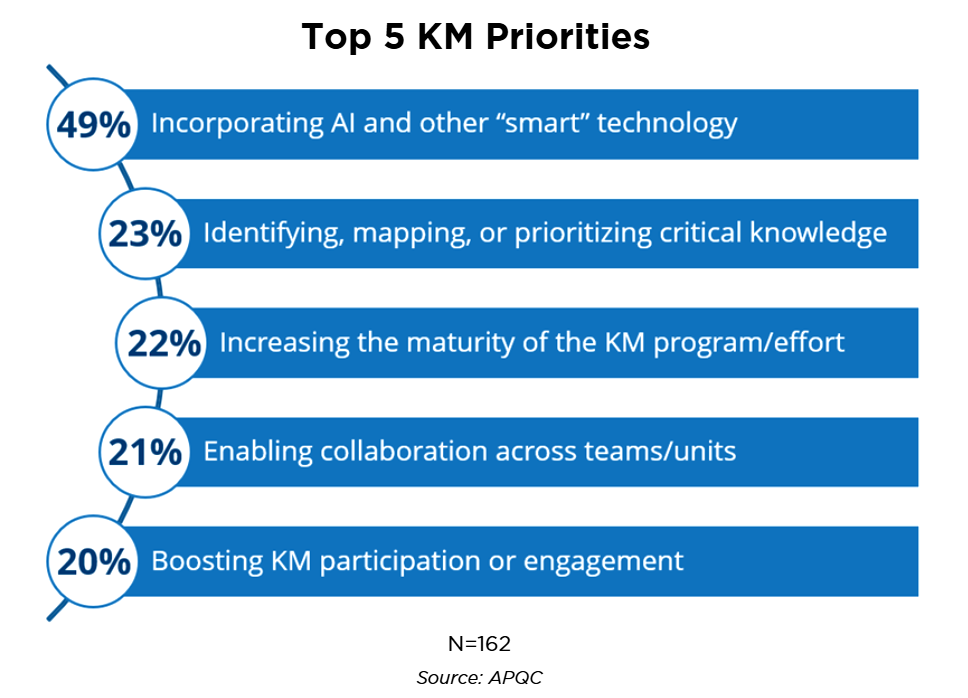
Fig. 1
Top KM Goals and Focus Areas
The top goals and focus areas for 2026 emphasize a focus on AI, driven by evolving generative AI capabilities, along with core KM objectives—the stuff only KM can do. While KM can and should support AI, digital transformation, and other technology-related initiatives where appropriate, KM professionals still recognize a need to focus on identifying, mapping, and prioritizing critical knowledge, increasing the maturity of KM programs, enabling collaboration across teams, and boosting employee participation and engagement in knowledge related activities. (Figure 1)
Incorporating AI/Generative AI and “Smart” Technology
Over the three years, KM professionals have been inundated with information about and demand for artificial intelligence (AI), specifically generative and agentic AI capabilities such as OpenAI’s ChatGPT, Microsoft Copilot, and Google’s Gemini. But traditional or legacy AI has been around for a long time now. In fact, according to TechTarget, the introduction of AI can be traced back to the 1950s.
The rapid rise of generative and agentic AI has moved these tools to the top of the priority list for both business and KM leaders. Beyond producing high quality, original content with generative AI, agentic AI introduces an entirely new level of capability—planning, taking multi step actions, and operating autonomously to achieve defined goals. With most KM professionals now reporting active involvement in their organization’s AI initiatives, KM teams are increasingly being called on to surface high value use cases and design AI enabled solutions that boost employee productivity, accelerate learning, and enhance organizational effectiveness.
To begin addressing AI demands within your organization, APQC recommends three actions to consider:
- Ensure there is a valid business case for AI and work with your organization’s leaders to develop use cases to experiment and learn before implementing AI broadly. Implementing technology simply because it's new and “everyone is doing it” will not lead to success and will further frustrate employees.
- Engage the right partners in the development of your AI strategy and implementation. IT should not be expected to drive this alone. It takes partnership with KM teams to ensure that the structure and relevancy of the organization’s content is sound. Effectively implementing AI also requires partnerships with functions such as Legal and HR to ensure ethics and intellectual property policies are enhanced, as well as the contributions of core functional teams to ensure continued alignment with business objectives and prioritization of AI use cases.
- Consider the impact on your workforce. AI is in the news every day and often instills strong emotions like fear, uncertainty, and excitement. Those involved in the implementation of AI should ensure a solid change management approach to engage early adopters and help other individuals prepare and adapt to a new era that includes AI.
Get Started
Why Most Enterprise AI Projects Fail—and What to Do About It
AI In Action: Transforming Knowledge Capture & Retrieval (Slides)
How Enterprise GenAI Transformed Knowledge Culture at Infosys
Identifying, Mapping, and Prioritizing Critical Knowledge
One reason why this priority is so urgent is the sheer number of organizations that are launching new or expanded KM initiatives. When you do that, it’s smart to start by exploring knowledge needs to ensure you’re effectively scoping your KM projects. Knowledge mapping and the prioritization of knowledge that is aligned to support business objectives help new and expanding KM programs understand what gaps, bottlenecks, and silos they most need to address.
Another driver of this priority is that even organizations with established KM programs are struggling with a proliferation of knowledge—especially digital content and information (e.g., growing data lakes, multiple team and project sites, chat, intranet, specialized repositories, and more). A lot of this content is poorly organized, particularly when it comes to virtual collaboration channels and outputs. It’s impossible for KM teams to actively “manage” all of this, so they must first identify what’s important or at-risk.
Moreover, and regardless of how established your KM program is, KM teams must continually redefine:
What knowledge is critical to capture and transfer;
what knowledge is in scope for active oversight (i.e., validation, review, taxonomy tagging, updating, and archrival); and
what new knowledge is emerging due to evolving technologies like generative AI.
Business strategies, processes, and technologies are evolving faster than ever before, and KM teams need to keep up and adapt to ensure they’re providing employees a direct line to the latest and greatest knowledge.
Get Started
Increasing The Maturity of KM Programs
A growing number of organizations are prioritizing KM maturity in 2026 as they recognize that the value of AI, collaboration, and content management depends on a solid KM foundation. Many teams are discovering that inconsistent processes, unclear ownership, and fragmented repositories create barriers to trusted, accessible knowledge. As a result, they are shifting toward building the core capabilities—governance, taxonomy, roles, and content lifecycle management—that support sustainable KM practices and better position their organizations to leverage emerging technologies.
A major driver of this priority is the inconsistency of KM capabilities across functions and business units. APQC’s KM maturity model emphasizes that organizations progress most effectively when they invest in a systematic operating model for KM that includes expectations for ownership, establishes a shared language, and clarifies which capabilities can be standardized enterprise‑wide versus decentralized. Many KM teams are using maturity assessments, such as APQC’s Levels of KM Maturity and the KM Capability Assessment Tool (KM CAT), to identify gaps, benchmark progress, and target areas of improvement where they will have the greatest organizational impact.
Ultimately, increasing KM maturity is about ensuring KM becomes a reliable organizational discipline rather than a series of projects. By strengthening governance, solidifying roles, and standardizing foundational practices, organizations reduce knowledge loss and enable more effective AI‑supported search, collaboration, and decision‑making. For many, 2026 represents a year of moving from “doing KM activities” to building an enterprise‑level ecosystem capable of adapting and improving over time.
Get Started
From Business Knowledge to Collective Intelligence: The New Edge in Performance
Top 10 Practices for High-Impact Knowledge Management Programs
Enabling Collaboration Across Teams/Units
APQC’s definition of collaboration refers to individuals working together on a shared task, project, or goal. Collaboration typically involves identifying roles, sharing knowledge, and creating consensus. Knowledge management is about enabling what most people want to do naturally—share what they know and learn from others. Some common KM approaches that enable collaboration include:
Communities of practice
Lessons learned
After-action reviews
Internal workshops or conferences
Peer assists
Communities of practice (CoPs) are networks of people who come together to share and learn from one another face-to-face, virtually, or both. Each community is held together by a common purpose, which usually focuses on sharing experiences and insights related to a topic or discipline. Communities perform a variety of knowledge-oriented tasks on behalf of organizations, including enabling collaboration and generating new ideas and innovations.
A lessons learned approach is a knowledge-sharing technique that helps employees work together and reflect on, capture, and transfer lessons and proven practices from projects or events. Lessons learned activities typically focus on questions such as:
What did we do right?
What could we have done better?
What needed skills, knowledge, and/or tools were missing on this project/event?
How can we improve to be more effective in the future?
Get Started
Support Networks: Communities of Practice at Collins Aerospace
Knowledge Chief at Ogletree Deakins Reflects on Team’s Hypergrowth and the Future of KM
Boosting KM Participation or Engagement
About one-fifth of KM professionals are focusing on boosting KM participation or engagement in 2026. This priority goes hand-in-hand with change management, with 40% of respondents citing it as a top skill for KM teams to develop. Change management to instill a culture of knowledge sharing not only means training employees to use knowledge sharing tools and approaches but also understanding why they may be resisting and helping them understand new ways of working.
The emotional connection an employee feels toward their organization will ultimately influence their behaviors and performance at work. For employees who are comfortable with their organization’s status quo, change can be both intimidating and unwelcome. Ensuring employees are engaged in the process of change is crucial to successfully implementing KM capabilities and behaviors in an organization.
Of course, change management is about more than just engaging line-level employees. Securing buy-in and sponsorship from executives and other leaders is also critical for driving effective change. A significant number of KM professionals (37%) believe the biggest threat to KM right now is that employees are overworked and don’t think they have time for KM. Driving adoption without support from top leadership will be difficult at best and likely flounder, especially if employees feel that leaders and executives don’t have or won’t make time for KM.
Organizations experiencing higher levels of success with KM engagement tend to:
Secure and engage with an active leadership sponsor
Conduct a gap assessment to understand resistance and where to focus the engagement strategy
Involve key stakeholders early and often
Leverage a centralized change management department or community of excellence
Ensure robust and targeted communications
Build flexibility into engagement plans to accommodate different stakeholders
Use peer-led training and existing communities of practice
Measure progress throughout an initiative, not just at the end
Include a reward and recognition structure for change leaders and early adopters
Get Started
Key Takeaways
The priorities shaping KM in 2026 reflect a dual reality: Organizations are eager to harness transformative technologies like generative and agentic AI, yet they also recognize that long‑term success requires strengthening core KM foundations. Teams are focusing not only on enabling smarter tools, but also on identifying critical knowledge, maturing their KM systems, enabling collaboration, and boosting engagement in knowledge sharing behaviors. Together these priorities highlight a need to balance innovation with discipline to ensure that the rapid expansion of knowledge and content across the enterprise remains accessible, accurate, and actionable.
Ultimately, each organization must tailor its KM strategy to the needs of its people, processes, and business goals. While trends offer some helpful direction, the most impactful KM programs are those grounded in clear business value and supported by strong leadership, intentional change management, and an enterprise‑wide commitment to sharing and stewarding knowledge. By aligning efforts across these priority areas, KM teams can strengthen their organizational knowledge ecosystems and position their companies to thrive in an increasingly complex and fast‑moving environment.
About this Content
This content can include median values sourced from APQC's Open Standards Benchmarking database. If you're interested in having access to the 25th and 75th percentiles or additional metrics, including various peer group cuts, they are either available through a benchmark license or the Benchmarks on Demand tool depending on your organization's membership type.
APQC's Resource Library content leverages data from multiple sources. The Open Standards Benchmark repository is updated on a nightly cadence, whereas other data sources have differing schedules. To provide as much transparency as possible, APQC will always attempt to provide context for the data included in our content and leverage the most up-to-date data available at the time of publication.
Contents
c: 1785737494