Reports & White Papers
|
September 30, 2025
Navigating the Great Retirement with KM & AI
c: 1785741312
Picture a typical day in your organization’s most experienced department—maybe it’s finance, engineering, supply chain, or customer service. The room is filled with people who know how things really work: Long-tenured experts who can troubleshoot issues, mentor new hires, and remember why certain decisions were made decades ago. Now imagine that half of them quietly log off for the last time. No formal handoff, no documentation of their insights, and no transfer of the lessons they’ve learned through decades of experience. The rest of the team is left with questions no one can answer and processes no one fully understands. =
Unfortunately, this scenario is not hypothetical. It’s a tangible risk that organizations are facing as more than half their front line workers over the age of 55 plan to leave or retire within the next five years. This exodus threatens to erode both tacit and explicit knowledge, particularly in industries like health care, manufacturing, construction, and utilities.
Baby Boomers, born between 1946 and 1964, are largely driving this profound shift. Members of this generational cohort not only occupy many leadership positions but also tend to have extensive expertise and invaluable institutional memory. But they won’t be part of the workforce much longer. Research by the Retirement Income Institute shows that more than 11,000 Americans will turn 65 every day from 2024 through 2027, equating to roughly 4.1 million people per year reaching retirement age.
Concern is Widespread—But Organizations Aren’t Meeting the Moment
To better understand the ‘Great Retirement’ and what it means for knowledge management (KM) programs, APQC partnered with eGain (a SaaS provider for AI CX automation) for a global survey of 1,000 organizations. We found that concern about knowledge loss from departing retirees is widespread, especially among senior leaders and board members (Figure 1). By contrast, fewer than one in 10 members of any group were “not at all concerned” about this issue.
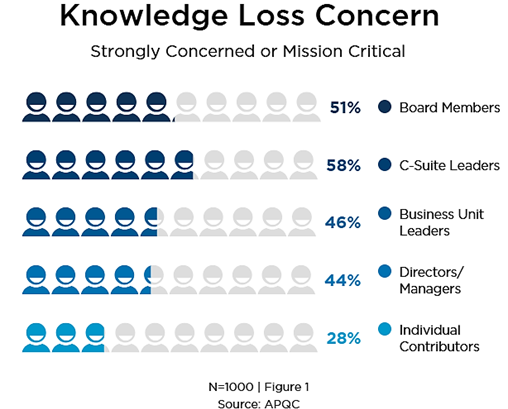
Fig. 1
While it’s clear that organizations are concerned about knowledge loss from the Great Retirement, few are fully prepared to meet the moment. Whether they lack consistent processes, a culture supportive of knowledge sharing, or are struggling to get buy in for new technologies, organizations across industries still have many opportunities to mature their approaches to knowledge capture and transfer.
Building the right capabilities to respond to the Great Retirement will take time, and time is running out. The good news is that we have discovered tools and approaches that are effective for reducing the risk of knowledge loss from retiring employees.
This white paper synthesizes our findings related to current state knowledge capture and transfer processes, AI adoption, and workforce readiness. Along the way, we also provide actionable insights and strategies to help you mitigate risk, improve KM maturity, and prepare for critical workforce transitions.
Current State Knowledge Capture and Transfer
Knowledge capture and transfer practices in many organizations are woefully inadequate for addressing the Great Retirement. For example, only eight percent of respondents said that their organization consistently captures knowledge from departing retirees, while 16% don’t even bother trying. Even the 22% of organizations that capture knowledge from retirees “most of the time” are at risk of having critical knowledge slip through their fingers as senior employees retire.
Lack of Buy-in is Creating Challenges
If KM teams and their organizations know that critical knowledge is at risk, what’s keeping them from acting? Many respondents told us their organizations simply aren’t providing the time, resources, or technology to do it effectively (Figure 2). In addition to missing these foundational resources, many organizations are struggling with cultural challenges like a lack of awareness and a lack of trust in the process.
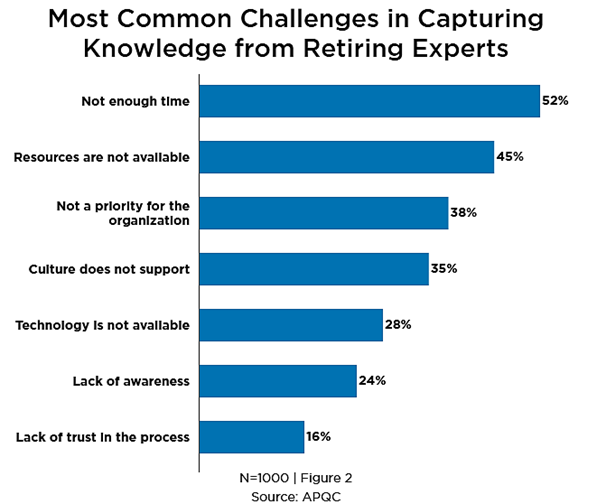
Fig. 2
Many of these challenges are driven by a lack of buy-in from senior leadership. For knowledge transfer to work effectively, leaders need to see its value, provide resources, and make it a priority by setting aside time for it. This means that KM teams will need to continually build the business case for knowledge transfer and identify executive sponsors who are passionate about supporting it.
Mature KM Programs Use Varied Approaches for Knowledge Transfer
Every KM team and organization should aim to consistently capture knowledge from departing retirees, but this does not mean that knowledge transfer needs to look the same in every case. For better or worse, there is no ‘one-size-fits-all’ strategy for knowledge transfer. While systematic approaches like formal mentoring are best for the kind of tacit knowledge that senior employees typically hold, KM teams should think creatively about the best way to approach each departing employee.
Honoring Expert Legacies Through Knowledge Transfer at TechnipFMC
TechnipFMC is a good example of an organization that takes a structured and proactive approach to knowledge transfer while also allowing some flexibility in each case. Faced with the risk of losing critical expertise due to retirements, the company developed a seven-step process that includes risk assessment, knowledge mapping, and customized knowledge transfer plans for each retiring expert. After identifying the expert and committing resources to the knowledge transfer project, the process steps include:
Developing the project plan
Conducting interviews with experts and the broader knowledge transfer community
Performing risk assessment to develop a focused list of high-risk knowledge that is unique and critical
Mapping knowledge, including the context, owner, purpose, and description
Developing a knowledge transfer plan to fill identified knowledge gaps, starting with the largest gaps in the most critical areas
Deploying the knowledge transfer plan, creating knowledge assets, and promoting them to the target audience
Closing out the project and celebrating
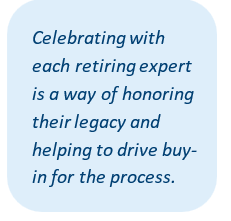
While the KM team uses a structured process, they also treat each departing expert as their own project, recognizing that personalities and knowledge styles can vary. The team also recognizes that knowledge transfer can be an emotional time for departing experts as they reflect on their legacy. Closing out the project and celebrating with each retiring expert is a way of honoring their legacy and helping to drive buy-in for the process.
Learn More
See the following APQC resources:
Transferring Expertise in the Age of AI
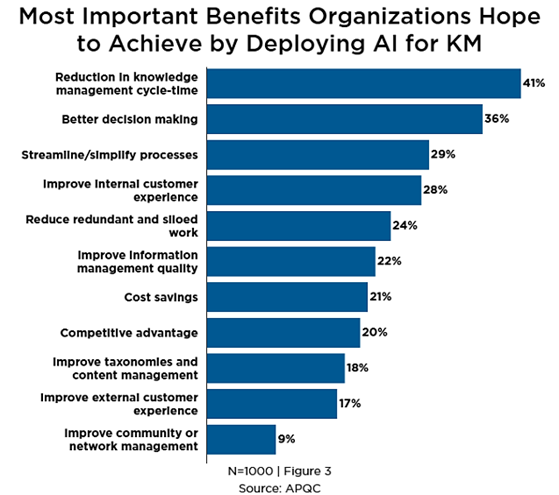
AI is emerging as a powerful enabler of KM. Organizations are adopting and implementing AI-driven tools to help reduce KM cycle times, drive better decision making, streamline processes, and more (Figure 3).
While organizations hope to achieve these benefits over time, AI is already making a difference when it comes to knowledge transfer. For example, one participant in a roundtable hosted by APQC said that after recording a video of an expert, the team can use AI to create a summary and PowerPoint slides. Another roundtable participant said that their organization uses AI to turn transcripts of conversations with experts into practice documents. Approaches like these can harvest critical knowledge even when time is extremely short.
Our roundtable participants shared a wide range of other AI use cases for transferring expert knowledge, including:
Recording interviews through workplace collaboration apps and sharing them
Training generative AI to ask experts questions to retrieve their knowledge
Using workplace collaboration tools to preserve files, recordings, and training
Putting expert knowledge into an AI repository that can read, summarize, and pull information from documents
AI can automate a lot of the work of expert knowledge capture by carrying out tasks like these.
Content Management is Foundational for Effective AI
While AI presents a lot of exciting new possibilities for expert knowledge transfer, it also raises new challenges. For example, without robust content management practices, AI can easily return results that are redundant or inaccurate.
Applying effective content management, a structured process to store, deliver, and facilitate access to enterprise assets, helps organizations avoid these types of scenarios. And governance is critical because someone needs to be responsible and accountable for:
Making sure content is consistent and accurate to train AI effectively
Managing the lifecycle of content so AI doesn’t replicate outdated or irrelevant content
Understanding AI’s capabilities for managing content and transferring knowledge
Evaluating AI-generated outputs for quality and accuracy
KM teams shouldn’t make themselves responsible for all of these tasks. Mature KM programs enlist key roles in the business to help with content management. Building content management responsibilities into existing roles for subject matter experts or leveraging communities of practice both help ensure that content from every part of the business is getting vetted and reviewed in a standard way. Leading organizations also establish KM liaisons in the business or leverage cross-functional steering committees to guide the work and provide support and resources from senior leadership.
The Importance of a Strong Taxonomy
Taxonomy is an important component of content management that is also vital for effective AI. Taxonomies help AI learn about the content, including the relationships across or among different categories of content, as well as between terms, topics, and domains. This makes AI more effective and prepares organizations to better reap the benefits of emerging technologies.
APQC recommends that organizations focus on four key practices for an effective taxonomy:
Design the taxonomy to reflect business needs and enable cross-functional knowledge discovery.
Make your taxonomy flexible enough to grow and change with the business.
Apply your taxonomy in a way that avoids overburdening content creators. For example, leading organizations use automated tagging to make the administrative work easier.
Leverage your taxonomy to accelerate search and discovery.
Barriers to AI Adoption
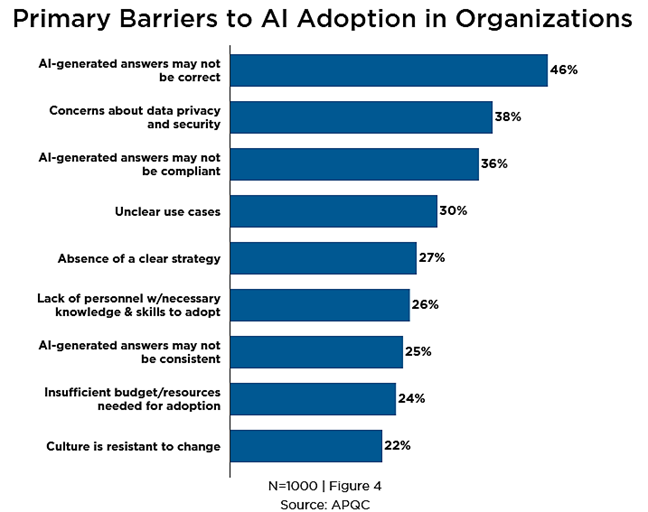
Adopting and implementing AI effectively is challenging even for the best KM teams. Figure 4 shows the most common barriers to AI adoption.
Barriers to AI Adoption are Largely Rooted in Governance and Content Management
Fears that AI will replace human workers and take away jobs often generate splashy headlines, but they’re not the biggest barriers to AI adoption. In fact, the top five barriers in Figure 4 all have to do with the need for more effective content management and more robust forms of human oversight. For example, identifying people who will be responsible for validating AI outputs can help address concerns over accuracy, while governing bodies like KM steering committees or communities of practice provide the governance needed for compliance and the development of a clear strategy. By contrast, only about one in five respondents (22%) said they struggle with cultural resistance as their primary barrier.
These findings do not negate the importance of addressing cultural resistance through effective change management (more on this below), but they do point to content management and governance as foundational but often missing components of an effective AI implementation.
Learn More
See the following APQC resources:
Preparing the Workforce for AI-Driven KM
The emergence of AI and the Great Retirement are both significant disruptions on their own. The fact that they are occurring together (and alongside many other disruptions) makes it even more important for organizations and KM teams to be intentional about how they prepare for the future. In this section, we provide five recommendations for how organizations can mitigate the risks of the Great Retirement and capitalize on AI’s potential.
Help Employees Transition to the Future
Preparing employees for a future that includes AI is becoming increasingly critical as organizations continue to adopt and implement AI-driven tools. Doing nothing and hoping for the best is not a good plan, but more than one in every 10 surveyed organizations are essentially taking this approach and have no plans to manage the transition for employees. Fortunately, a majority of respondents say their organizations are taking a more proactive approach (Figure 5).
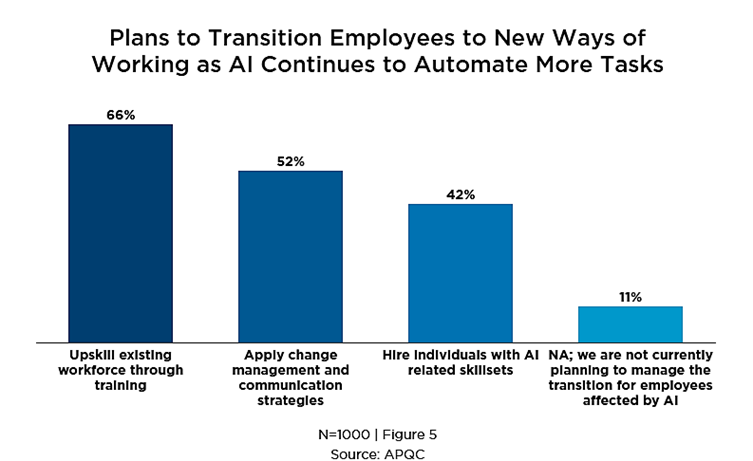
Two-thirds of respondents said their organization plans to upskill existing employees through training, while more than half said they are using change management and communication strategies to help employees transition. Both of these approaches are vital for helping employees understand their role in an AI-driven future.
Invest in AI-Enabled KM Platforms
It’s already clear that KM programs across industries are benefitting from the use of AI. Technology available today from a wide range of different vendors can help to automate knowledge capture and make sharing knowledge seamless. Figure 6 shows examples of AI-enabled systems that organizations are using today. Common KM systems in use include Confluence (Atlassian), eGain, Microsoft SharePoint, and ServiceNow, all of which include embedded AI.
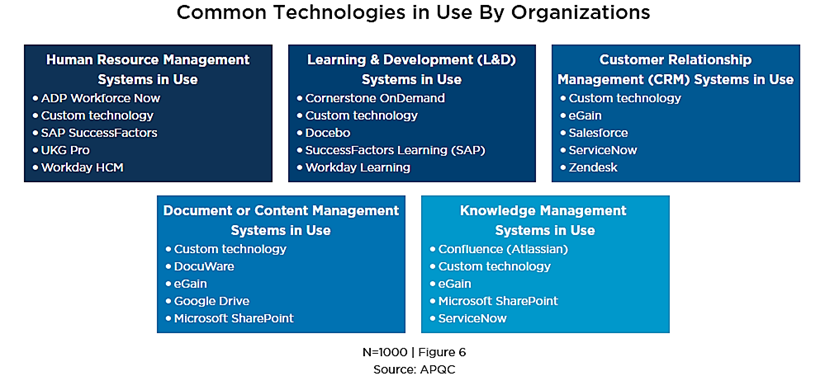
This list is not exhaustive. The sheer number of tools and vendors in the marketplace today can be overwhelming, and it can feel difficult to cut through the hype. As you consider what’s right for your KM program, APQC has three broad recommendations:
Focus on concrete business needs and pain points and find the tools that best address them. Let the KM strategy define your toolkit—not the other way around.
Don’t do it alone. Partner with IT and other relevant stakeholders to consider the upstream and downstream implications of the tools and technology you chose.
Align your work with broader digital transformation initiatives. Potential cost savings, productivity gains, and new revenue streams from the use of AI are capturing executives’ attention and already drawing funding and energy. If you can align KM’s technology business case with these broader efforts, you may be more likely to get a green light. In addition, KM may be able to use digital tools that are already being implemented to improve knowledge capture processes without additional investment.
Integrate KM with Enterprise Systems
KM adds significant value to organizations when it helps people transition to new tools and ways of working. But KM should never do this work alone, and typically it doesn’t. KM teams are used to leveraging partnership for the success of their programs, and AI is no different. The key is to develop relationships, establish trust, and make meaningful contributions to joint endeavors.
As KM maturity grows, so does the integration of KM tools with the broader systems environment. At the highest level of maturity, KM tech improves automatically through self-learning systems. AI and machine learning algorithms can also scrape information from both KM and non-KM systems (like HR databases) to uncover emerging knowledge needs and push relevant knowledge to employees when they need it.
If you’re just beginning this journey, APQC recommends the following practices to ensure effective integration:
Partner with IT, HR, and other relevant functions and collaborate for systems integration. Show stakeholders the benefits of KM system integration in areas like HR. For example, making it easier for employees to access resources about their benefits is a win not just for KM but for HR and the organization more broadly.
Have a plan for integration before you implement new technology. If ease of integration is not a formal part of your selection criteria, you should at least understand the integration opportunities and limitations involved with different tools.
Stay connected. Because KM needs to maintain partnerships with other business functions so often, it’s easy for the relationship to turn transactional. Put in the work to build a meaningful partnership by continually demonstrating interest in their goals and seeking ways to support them while remaining focused on mutual goals.
Build cross-functional KM teams
The skills that KM teams need for success are changing in line with emerging technology, the Great Retirement, and other macrotrends. Cultivating a cross functional team helps ensure that KM can meet the diverse roles that it is expected to play in today’s organizations. As APQC Chairman Carla O’Dell points out, “You need at least four people on the team who embody different skill sets. You need someone with expertise in communications, someone for technology, someone with change management skills, and someone with the right skills to run communities. All of those are important skillsets and you can find people who have them in a lot of different places.” Respondents to APQC’s People of KM survey also identified skills including:
Critical thinking (89% of respondents)
Relationship building (87% of respondents)
Emotional intelligence (79%)
Process management (76%)
Technology fluency (63%)
Data management (57%)
Simply put, KM teams today need a mix of technical skills, deep work skills (e.g. critical thinking), and social skills (e.g. emotional intelligence, relationship building) for ongoing effectiveness.
Improve Change Management Effectiveness
AI adoption represents a significant cultural transformation for many organizations. Some employees might not have the skills they need to embrace AI without additional training and upskilling. Others might resist having to change the way they work, especially if their organization has undergone a lot of change already. Change management is vital for addressing these issues and preparing employees to successfully transition through change.
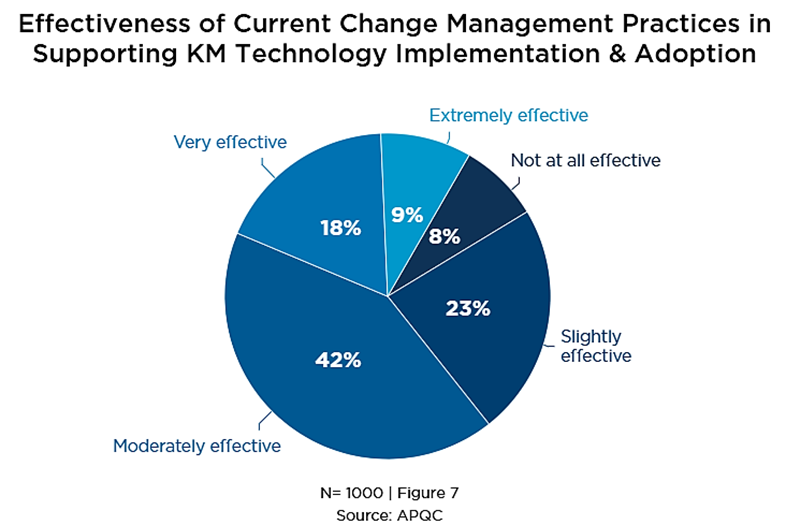
Unfortunately, many organizations do not have the change management maturity they need to meet these challenges effectively. More than two-thirds of our respondents said that their change management practices are only moderately effective at best for driving successful technology implementation (Figure 7). Only slightly more than a quarter (27%) rated their change management as very or extremely effective.
Over decades of research, APQC has discovered effective change management practices that contribute to the success of any organizational change, including AI. Some of the most effective include:
Gaining buy-in and support from leaders
Using a structured approach to change
Using two-way communications to explain what change means for employees and collecting their feedback
Planning and delivering effective training so employees know their role in change
Measuring the impact of change
Change management is both an art and a science. In addition to the practices above that are proven to be effective (i.e., the science of change management), make sure to keep strengthening skills that speak to the interpersonal dimensions of culture change: The ability to listen to stakeholder concerns and show empathy, tell stories about why change is needed, help people solve problems, break down barriers, and more.
Learn More
See the following APQC resources:
Measuring the Impact of Knowledge Transfer
Measurement not only validates the impact of knowledge transfer efforts but also helps KM teams refine their approaches, secure leadership buy-in and demonstrate business value. Below, we discuss four types of measurement that are all vital for tracking the success and effectiveness of your knowledge transfer activities.
Adoption and Participation
Measures of adoption and participation, such as usage rates of KM platforms, attendance in knowledge transfer activities, and contributions to knowledge repositories, reveal the degree to which employees are actively involved and where KM might need to make additional outreach. These measures also help to identify pockets of resistance or disengagement that could undermine knowledge transfer efforts.
Cost, Efficiency, and Quality
Cost and efficiency measures help KM teams and their organizations better understand the ROI of knowledge transfer initiatives. For example, measures like time saved, reduction in rework, and improved cycle times for onboarding or project completion can offer tangible evidence of the value of knowledge transfer. Quality indicators like the accuracy, relevancy, and useability of resources created through knowledge transfer help to ensure that the process isn’t only efficient, but effective as well.
Engagement and Satisfaction Measures
Methods like surveys, interviews, and focus groups help KM teams understand how end users experience KM tools and processes. Measuring KM’s business value is often difficult, but data showing that end users consider KM tools and approaches to be valuable can be a useful sign that KM is on the right track. Satisfaction measures also provide insight into what is and isn’t working from an end-user perspective, which helps the KM team know where to focus its limited resources for improvement.
Success Stories
In the context of KM, success stories typically focus on how a particular individual or team benefitted from reusing available knowledge in the course of their work. While success stories aren’t a replacement for quantitative measurement, some stakeholders find them very compelling because they represent real-life situations rather than abstractions. APQC’s 2025 KM Program Benchmarks and Metrics research shows that 38% of KM programs not only document success stories but also assign a dollar value to each story to show the impact to the business.
Business Outcomes and Value
When choosing business outcome measures to tie to knowledge transfer activities, you should consider which measures leaders care about and where you can logically draw a connection between KM and business performance. For example, if a knowledge transfer initiative is focused on customer service, it may make sense to look at the impact on customer satisfaction or retention.
Through our 2025 KM Program Benchmarks and Metrics research, APQC found that tying KM to almost any business outcome KPI boosts the likelihood that KM will demonstrate significant business value. For example, KM programs that explicitly measure speed of innovation or time to market are significantly more likely to say they deliver an enormous or a lot of business value, compared to those that do not (67% versus 43%). The same is true for revenue gain: Two thirds of KM programs that explicitly measure this outcome against KM activities say they deliver enormous or a lot of business value, compared to 44% that do not track this measure.
Learn More
See the following APQC resources:
Call to Action
The Great Retirement is more than a demographic shift. As experts start to retire in larger numbers, not having the right people, processes, or technology in place is going to become increasingly challenging and costly for organizations to address. Organizations and their KM programs need to act now to strengthen their practices, embrace AI, and invest in change management to thrive in a rapidly evolving landscape.
To keep moving forward, KM leaders should:
Build a knowledge strategy aligned with retirement risk. Partner with your HR and Learning and Development functions and design a strategy to prevent and close knowledge gaps left by retiring experts.
Integrate AI thoughtfully into workflows. AI is already helping organizations to capture critical knowledge, but it takes more than the flip of a switch. Governance and content management are critical success factors for getting value from AI.
Prepare your organization’s culture for AI. Many employees may need training and upskilling, and some will resist having to learn new technologies and processes. Continue maturing your change management capabilities to help people make these transitions and understand what AI means for them.
Assess and continually improve your knowledge management maturity. APQC’s knowledge management capability assessment tool (KM-CAT) is a great resource to help you get started.
Learn More
See the following APQC resources:
APQC’s Collection on Artificial Intelligence (AI) for Knowledge Management
APQC’s Collection on the People of KM: The Future of KM Roles & Expertise
Sponsor’s Perspective: eGain
Turning the Great Retirement Crisis into Your Greatest Strategic Advantage
The statistics are stark and undeniable: 11,000 Americans turn 65 every day through 2027, taking with them decades of institutional knowledge, hard-won expertise, and irreplaceable tribal wisdom. For CXOs and board members, this isn't just an HR challenge—it's an existential threat to operational continuity and competitive advantage.
But what if this crisis could become your organization's defining strategic opportunity?
As APQC's comprehensive research reveals, while 84% of senior leaders express concern about knowledge loss from retiring employees, only 8% of organizations consistently capture this knowledge. This gap represents more than operational risk—it's a massive competitive blind spot that forward-thinking organizations can exploit.
The Hidden Value of Institutional Knowledge
Your retiring workforce doesn't just possess technical skills; they hold the "why" behind critical decisions, the context that turns data into wisdom, and the relationship capital that keeps complex operations running smoothly. When a 30-year veteran in manufacturing walks out the door, they take with them not just process knowledge, but the ability to troubleshoot anomalies, mentor successors, and navigate the unwritten rules that make organizations truly function.
Traditional knowledge transfer approaches—exit interviews, documentation projects, mentoring programs—are necessary but insufficient for the scale and urgency of the Great Retirement. They're manual, inconsistent, and often capture explicit knowledge while missing the tacit insights that drive real performance.
AI: The Strategic Multiplier for Knowledge Preservation
This is where trusted AI knowledge infrastructure transforms crisis into opportunity. Modern AI doesn't just store information—it captures, contextualizes, and democratizes institutional wisdom at enterprise scale. Imagine automatically converting decades of expert conversations into searchable, actionable knowledge assets. Picture AI that doesn't just document processes but understands the nuanced decision-making that separates exceptional performers from average ones.
Organizations leveraging AI for knowledge management are already seeing dramatic results: reduced onboarding time, decreased errors, improved decision-making speed, and most critically, preserved competitive advantages that would otherwise walk out the door with retiring experts.
The Board-Level Imperative
The Great Retirement isn't a future concern—it's happening now. Every month of delay means more irreplaceable knowledge lost forever. But organizations that act decisively can turn this demographic shift into sustainable competitive advantage.
The strategic opportunity is threefold: First, systematically capture and preserve the knowledge of departing experts. Second, use AI to make this knowledge accessible and actionable for remaining and new employees. Third, create a knowledge-powered organization that's more resilient, agile, and capable of sustained high performance.
Many of our clients are already on this transformational journey, propelled by AI Knowledge:
Multinational Financial Services Provider
First Contact Resolution (FCR) up by 36%
Contact center gent training time slashed by 40%.
Hypergrowth SaaS Company
Contact center agent confidence up 60%
Self-service adoption up by 30%
Mammoth Federal Government Agency
70% of incoming calls deflected to self-service
Case handling time reduced by 25%
Top score in agent engagement benchmarks across agencies: 92% versus industry benchmark of 67%
Leading utility
Knowledge creation and curation speed up 5X
Search success up 6X
The Time for Action is Now
The companies that emerge stronger from the Great Retirement won't be those that simply weather the storm—they'll be the ones that harness AI to transform institutional knowledge from a liability into their greatest strategic asset. The question isn't whether your organization can afford to invest in AI-powered knowledge infrastructure; it's whether you can afford not to.
The Great Retirement is reshaping the competitive landscape. Will your organization be a victim of knowledge loss, or will you leverage trusted AI to capture, retain, and multiply the wisdom of generations? The choice—and the window for action—is yours.
About eGain
eGain helps businesses improve experience and reduce cost by delivering AI CX automation powered by Trusted KnowledgeTM and consumable answers. For more information, visit www.egain.com.
About this Content
This content can include median values sourced from APQC's Open Standards Benchmarking database. If you're interested in having access to the 25th and 75th percentiles or additional metrics, including various peer group cuts, they are either available through a benchmark license or the Benchmarks on Demand tool depending on your organization's membership type.
APQC's Resource Library content leverages data from multiple sources. The Open Standards Benchmark repository is updated on a nightly cadence, whereas other data sources have differing schedules. To provide as much transparency as possible, APQC will always attempt to provide context for the data included in our content and leverage the most up-to-date data available at the time of publication.
Contents
c: 1785741312