The APQC Blog
All Posts
Social links
Smart HR
Learn how your HR function can work smarter by more formally managing HR knowledge.
I’ve been writing a lot lately about the shortage of technical skills plaguing organizations in the aerospace, energy, engineering, and many other industries. But, there is another skills shortage that I want to call attention to: an HR skills shortage.
In its latest survey of Chief Human Resource Officers (CHROs), Cornell University’s Center for Advanced Human Resource Studies (CAHRS) found:
How to Differentiate on Fees Without Lowering Your Rates
The rise in sophistication among buyers of consulting services isn’t just changing what they’ll buy or what they prioritize when forming and narrowing down short lists (as we’ve reported in this blog the last two months). Today’s clients are radically changing how they expect to pay for consulting services.
To Offshore or Reshore?
Has your organization looked closely at whether offshoring manufacturing is the best choice? During a recent Webinar, Harry Moser of the Reshoring Initiative discussed how organizations can calculate the total cost of ownership for offshoring manufacturing. The Webinar was hosted by APQC and the Association for Manufacturing Excellence (AME) Benchmarking Community of Practice (CoP).
Reduce General Accounting Costs
Contrary to popular belief, large, corporate accounting functions have unwittingly retained a lot of waste and inefficiencies in their processes. Despite a decade of cost reduction and process optimization, CFOs and controllers are still not leveraging the cost-reduction power of shared services centers.
Using SharePoint for Information Governance
People are always begging me for more SharePoint content, so I’m happy to announce that APQC has published a new SharePoint case study. It focuses on Chevron’s Procurement and Supply Chain Management function, which is building a SharePoint system to house reference information, working documents, and communities of practice.
Cut the Clutter of Random Acts of Improvement
When discussing process management and improvement, I often talk about the concept of “random acts of improvement.” People, with good intentions, are off trying to make their part of the organization better, more efficient, simpler. But often these changes are done locally, in silos, without considering the end-to-end impact of the change – how that change might have a positive or negative effect elsewhere in the organization.
Tool: Quickly Set Your Technical Talent Priorities
How prepared is your organization to attract, develop, and retain technically skilled workers? APQC’s new Technical Talent Management Assessment* tool can help you answer this question.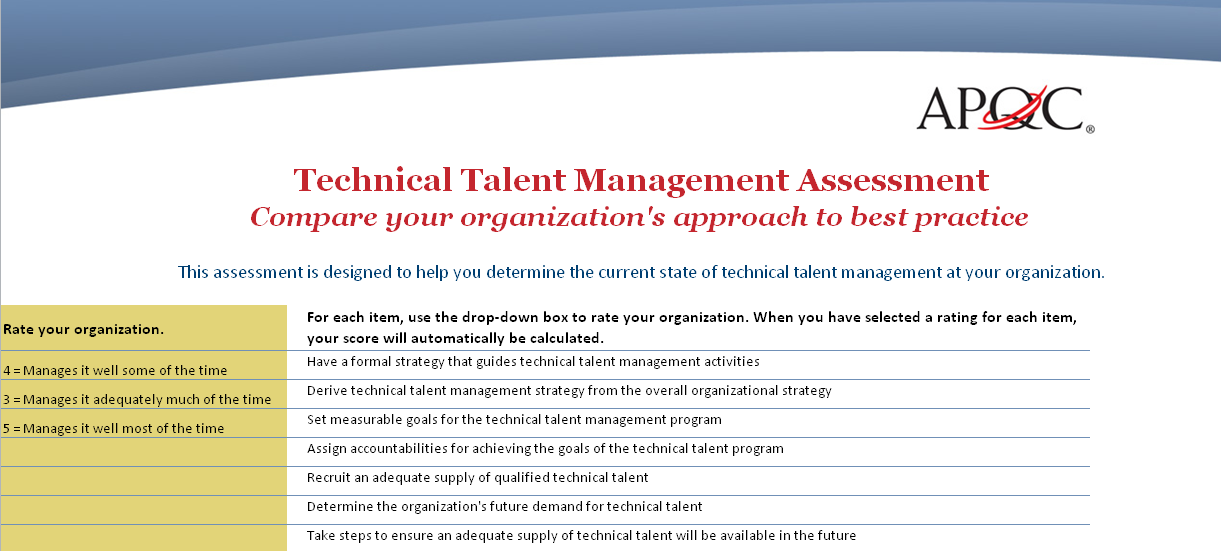
* Open to nonmembers for the month of July.
An Update on Supply Chain and Product Development Content
Did you know that APQC has created or updated 87 pieces of supply chain management and product development content since the beginning of 2012? Find out what’s new in the presentation Now in the Knowledge Base: Supply Chain Management.
Who’s Responsible for Managing International Risk?
Sparked by Walmart’s recent scandal in Mexico, CFOs are anxious to learn how the company should have dealt with the situation. What exactly is the difference between a “facilitation fee” and a bribe? How can an organization stay legal in foreign markets where legislation is—at best—ambiguous? What should organizations do to prepare for the next “black swan” event? Who ultimately is held responsible for accounting and reporting errors abroad?
Putting Knowledge in the Flow of Work
APQC’ newest report, Putting Knowledge in the Flow of Work, looks at how top organizations move KM to center stage by building knowledge sharing into the processes and frameworks that guide their operations.