The APQC Blog
All Posts
Social links
True Grit: More Than a Movie
APQC research shows that a growing number of financial executives have resolved that traditional approaches for managing business performance are no longer adequate.
As large organizations struggle to plan and execute growth strategy in an economic recovery that is hard to read, many are embracing a paradigm shift which, although not new conceptually, now stands a very good chance of changing the way businesses control and deploy resources.
New Product Development - Best Practices and Performance Metrics
Want to know how leading organizations keep their innovation processes rigorous yet flexible? APQC gathered data from 250+ organizations and created two reports: the first is more qualitative and focuses on the best practices. The second is quantitative and highlights the metrics and benchmarks of the best performing organizations.
How’s Your KM Budget Doing?
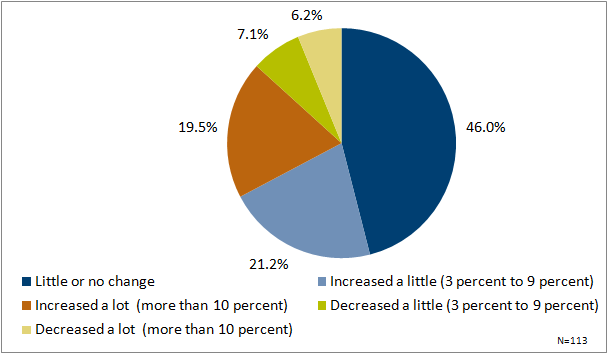
At APQC’s KM conference this year, Carla O’Dell asked the audience how their KM budgets had fared in the last year. The results were mixed, but mostly positive: Almost half the attendees said there had been little or no change between 2010 and 2011, while another 40+ percent said their budgets had increased.
What happened to your KM budget in 2011, compared to 2010?
Logistics Keys to Success
How does logistics impact the entire organization? Want to learn how to know if your organization is performing well? APQC has released a second edition of our popular Blueprint for Success: Logistics. It includes key measures, selected metrics, best practices, and case examples from successful organizations.
Can't See the Forest for the Tree Diagrams?
Process management can become a very insular activity. Process-focused teams pore over business documentation, interview key employees, and painstakingly map out the way the organization conducts business. As definitions are written, designs drawn up, and reports presented to executives, some teams develop a kind of process-myopia, losing sight of the ultimate vision of process management: delivering a product or service to a customer more effectively and with higher customer satisfaction.
Seven Reasons HR Should Care About Change
What is HR’s role in managing change at your organization?
At APQC, we have been researching organizational change for a long time. Now, more than ever we think change is a topic that should be on the mind of HR professionals. Why?
Shared Services Do It Better
Shared services centers are thriving. Organizations are now brainstorming to discover other departments and services can fit into the shared services center framework. And why? Existing shared services centers are more efficient, more productive, and cost less.
Two Heads Are Better Than One
Teamwork isn’t just for the volleyball court anymore. Phenomena like Amazon.com user reviews and Wikipedia have taught us about “the wisdom of crowds” while Web-enabled tools have made it possible to partner with people anywhere in the world. As a result, more and more organizations are asking employees to apply their collective knowledge to tackle tricky problems and come up with new and innovative ideas.
Blue Coat Found the Green by Going Green
Green Supply Chains Are Good for Business was Blue Coat Systems key takeaway when it revamped its entire supply chain. It revisited product design, logistics, and energy consumption. And found that going green helped save money.
Seven Tenets (Not Tenants) of Process Management
No, not the “seven tenants of process management.” We’re not asking you to get seven experts to move into your facility, pay rent, and magically imbue your business with process management power. Tenets, my friends.
How do you know if you are really managing according to processes? How do you begin to move to a process management structure? How do you ensure that your process management program is fully optimized?