Most organizations understand the value of benchmarking. The challenge isn't deciding whether to benchmark, it's figuring out how to turn benchmarking insights into meaningful improvements.
I've seen organizations spend months collecting data, comparing performance, and identifying gaps, only to struggle when it's time to act on what they've learned. The problem usually isn't the benchmarking itself. It's that organizations focus on the comparison and not enough on what comes next.
The organizations that get the most value from benchmarking approach it as a learning and improvement process, not just a data exercise.
Start with the Problem, Not the Data
One of the biggest mistakes organizations make is launching a benchmarking effort before clearly defining what they're trying to improve.
Before gathering data or identifying benchmarking partners, ask yourself:
- What business challenge are we trying to solve?
- Which process isn't performing the way we need it to?
- What outcome are we hoping to improve?
Answering these questions helps ensure that your benchmarking effort stays focused on generating actionable insights rather than creating a collection of interesting metrics.
Look Beyond Your Industry
When organizations think about benchmarking, they often start by looking at competitors. While industry comparisons are important, they rarely lead to breakthrough improvements.
The reality is that many organizations already have a general understanding of how their peers perform. The bigger opportunity is learning from organizations outside your industry that excel at similar processes.
A healthcare organization can learn from a logistics company. A manufacturer can learn from a retailer. The goal isn't to copy what another organization does; it's to understand the practices behind strong performance and determine how those practices might apply in your own environment.
Follow a Structured Approach
The most successful benchmarking initiatives don't happen by accident. They follow a deliberate process.
At APQC, benchmarking efforts typically move through four phases:
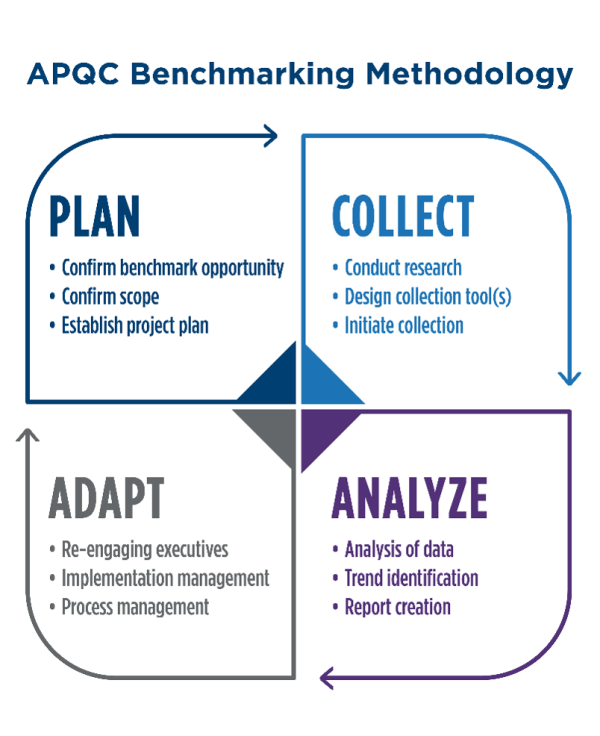
- Plan: Define objectives, identify the process to study, and determine which organizations and practices are most relevant.
- Collect: Gather both quantitative and qualitative information. Performance data tells you where gaps exist. Conversations and best-practice research help explain why those gaps exist.
- Analyze: Identify performance differences and uncover the practices driving superior results.
- Adapt: Develop an action plan to implement what you've learned and monitor progress over time.
Notice that only one phase focuses on collecting data. The majority of the work involves understanding, interpreting, and applying what you've learned.
Don't Stop at the Performance Gap
Finding a performance gap is valuable. Understanding what's causing it is where the real value lies.
This is where improvement tools can help.
Process maps and SIPOC diagrams can help teams understand how work currently flows. Root cause analysis can uncover the factors contributing to poor performance. Pareto analysis can help prioritize improvement opportunities when resources are limited.
These tools help organizations move beyond the question of "How do we compare?" and toward the more important question: "What should we do differently?"
Remember That Benchmarking Is a Learning Process
One theme consistently shows up in successful benchmarking efforts: organizations that are willing to learn gain the most value.
The best benchmarking projects create opportunities for conversations, relationship building, and knowledge sharing. Metrics may highlight a gap, but discussions with high-performing organizations often reveal the practical insights needed to close it.
That's why benchmarking works best when organizations approach it with curiosity. The goal isn't to prove you're performing well, or poorly. The goal is to understand how performance can improve.
Turn Benchmarking Insights into Action
At the end of the day, benchmarking isn't about collecting data. It's about improving performance.
Organizations that see the greatest results treat benchmarking as part of a broader continuous improvement strategy. They identify opportunities, learn from others, adapt best practices to their own environment, and measure progress over time.
The benchmark itself is only the starting point. The real value comes from what your organization does with the insights afterward.