
A knowledge manager is a vital professional who orchestrates the flow of information within an organization. They craft and oversee processes that capture, store, and share valuable insights, ensuring that the right people have access to the right knowledge at just the right moment. By doing so, they enhance decision-making and fuel business success.
In short, knowledge managers are key players in unlocking the full potential of an organization’s intellectual assets, maximizing the value of what it knows, and ensuring that it thrives in a competitive landscape.
What is Knowledge Management?
Knowledge management (KM) is the application of a structured process to help information and knowledge flow to the right people at the right time. This enables employees to efficiently and effectively find, understand, share, and utilize knowledge to create value.
For example:
- Reusing lessons learned from past projects to avoid errors and deliver better results faster
- Providing easy access to answers so employees can quickly respond to customers' questions and needs
- Capturing the most critical information and reusable know-how from an expert before he or she retires
- Offering employees time and space to brainstorm and build on each other’s ideas and experiences
- Distilling the information new hires need most to get up to speed
Learn more and tap into tips and best practices for knowledge management in APQC’s Understanding Knowledge Management.
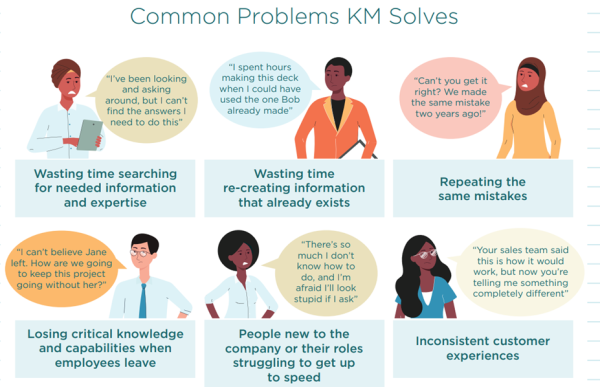
Dive into what knowledge management (KM) is, the business problems it helps solve, and eight common tools and approaches included as part of enterprise KM strategies.

WHO is a Knowledge Manager?
Today's knowledge managers are diverse and multifaceted professionals who play a crucial role in enhancing organizational effectiveness by analyzing, organizing, and disseminating information across various departments. They are responsible for curating and maintaining knowledge repositories that serve as valuable resources for teams, ensuring that critical information is easily accessible and up to date. Additionally, amongst other tasks, knowledge managers ensure experts are connecting, they facilitate training sessions and workshops, and equip employees with the necessary skills to effectively navigate and embrace change.
Put simply, knowledge managers do a lot.
A recent study by APQC involving over 400 KM professionals revealed the reality behind these everyday knowledge heroes. The findings cover demographics, education, experience, current skills, and future expectations. The research emphasizes the role of subject matter experts in promoting effective knowledge transfer and the successful implementation of knowledge management (KM) strategies
Learn more about today’s Knowledge Manager in APQC’s People of KM Roles and Expertise collection.
How do I become a Knowledge Manager?
APQC provides multiple pathways to develop or enhance your skills as a knowledge manager.
With self-paced virtual trainings to in-person accredited certifications, your dream of becoming a knowledge manager is closer than you think!
APQC training and certification courses provide efficient and cost-effective tools to enhance individual and organizational performance. The curriculum covers key knowledge management (KM) essentials, including business case development, essential tools and techniques, and measuring effectiveness.
Explore APQC’s training class catalog for upcoming courses.