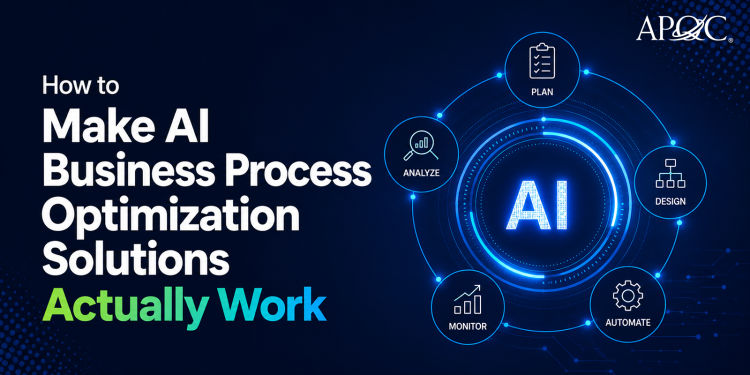
AI business process optimization solutions can help organizations work faster, reduce manual effort, improve decision-making, and create more consistent outcomes. But APQC's article, AI Is Not the Strategy: Why Process-First Thinking Still Wins (Members Only), makes an important point: AI is not the strategy by itself. The real value comes when organizations use AI to improve how work gets done across clear, governed, and measurable business processes.
AI Business Process Optimization Solutions Start with Process Design
It is easy to get excited about a new AI tool. A team finds a use case, launches a pilot, sees promising results, and assumes transformation is underway. Then reality sets in: adoption stalls, teams keep using old workflows, and the new tool becomes one more disconnected solution.
According to APQC research (Members Only), AI business process optimization solutions are most effective when organizations begin with clearly defined processes, trusted data, governance, and adoption planning, not technology selection alone. APQC's research cautions that a technology-first approach can lead to fragmented implementations, unclear ownership, and low adoption, while a process-first approach helps ensure AI improves measurable business outcomes and how work actually gets done.
The same preparation mindset shows up in APQC's Preparing for AI and Process Automation (Members Only), which emphasizes that organizations should address security, compliance, data and process management, training, and change management before implementation. Before choosing an AI tool, teams should ask:
- Are decisions faster?
- Are outcomes more consistent?
- Is risk reduced?
- Are handoffs clearer?
- Can employees realistically use, scale, and share the outputs?
This process-first mindset matters because AI tends to amplify whatever conditions already exist. A strong process can become faster and more reliable. A broken process can simply produce inconsistent results at greater speed.
How to Scale AI Business Process Optimization Solutions
Scaling AI requires more than a successful pilot. Organizations need a shared process framework, clear ownership, trusted data, and visible adoption metrics. Without those foundations, experimentation can create multiple tools, inconsistent approaches, and limited scalability.
Human review also matters. APQC's roundtable takeaways note that AI-generated process documentation and outputs should be vetted, refined, and quality checked before broad use. That is especially important when AI supports decision-making or produces content employees will rely on.
For leaders, the lesson is straightforward: do not measure AI success by deployment alone. Measure whether the solution is adopted, trusted, and embedded into daily work. That means involving process owners early, aligning AI projects with process architecture, tracking usage through dashboards, and communicating how automation will help employees focus on higher-value work.
The best AI business process optimization solutions are not standalone technology projects. They are process improvement efforts enabled by AI. When organizations combine clear process design, trusted data, governance, and thoughtful change management, AI can move beyond experimentation and become a practical driver of better business performance.
APQC source content used
- AI Is Not the Strategy: Why Process-First Thinking Still Wins
- Preparing for AI and Process Automation
Note: Some resources linked in this blog are available exclusively to APQC members and may require a member login to access. If you are not an APQC member and would like to learn more about membership and its benefits, click here.