APQC recently talked to Shelley Sweet, president of i4 Process, about why overcoming roadblocks to implement process improvement initiatives proves to be so difficult. She provides a unique 3-PEAT method of modeling processes and analyzing data that accelerates operational improvements, and builds leaders and employees who sustain operational excellence.
Shelley will be leading a breakout session at APQC’s 2016 Process Improvement Conference Oct. 3-7: Why Improvements Evaporate: How to Take 3 steps Forward Without 2 Steps Back.
You can find Shelley on LinkedIn or on Twitter @i4process.
Q. What are some common reasons process improvement initiatives gain traction initially, but six months down the road fall flat?
Process improvement initiatives gain traction initially for many reasons:
- There is pain in the organization where a process is underperforming.
- There is a need to grow substantially and the current process is not capable of scaling.
- New regulation is imminent and the current process cannot meet its requirements
In the beginning of an initiative the business need is obvious and executives dedicate time and company resources to working on it. The improvement team is excited about what they discover and the recommendations they find. Then implementation comes and real work gets in the way; there are new players who are not as dedicated, and other projects become priorities. The new process takes second fiddle to their other projects. Even if implementation is successful without ongoing monitoring, the process can fall back to where it was before the improvement initiative. Like in physical exercise, the body does not become toned, or stay toned without discipline, and discipline must be regular, maybe even daily.
Q. What are some tips organizations can use to set up process improvement initiatives that will have long-term success?
Here are some tips expressed with a sports metaphor:
-
See where the ball is now and know where you want to go.
-
Get the right leadership and team ready to play and then play hard and well.
-
Be thinking about a plan for four quarters, not just the first quarter.
-
Keep your eye on the ball. Don’t be dragged down by resistors. Don’t be enticed by shiny new things. Recognize your challenges early and take action.
-
Be persistent and plan for the next game, and the rest of the season. This is not a one game competition.
Q. What are the three stages to operational excellence?
The 3E model below provides an approach for any organization to think about how it can start, grow, and make process improvement durable. With this approach the organization improves customer satisfaction, operational efficiency, and execution excellence.
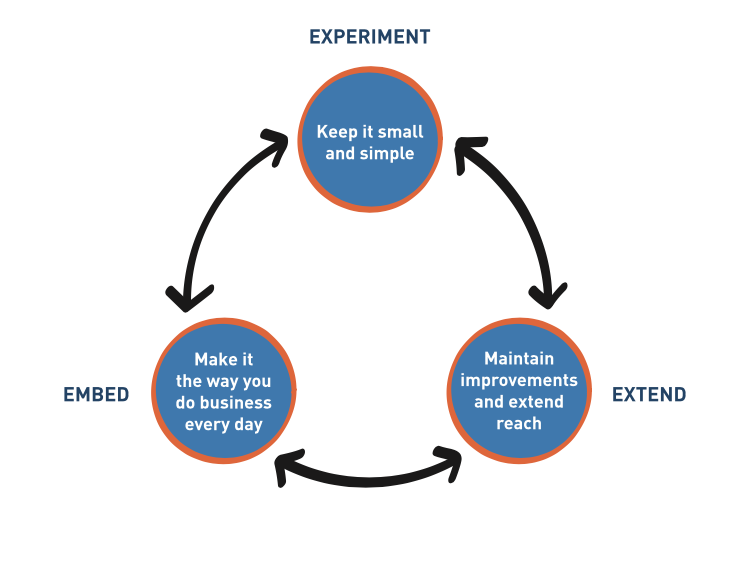
The best approach for initial process improvement projects in any organization is to Keep It Small and Simple. The organization’s next challenge is making the improvements stick. Over time after a new implementation, changes can backslide. So knowing how to extend improvements to new functions is critical. In the third stage called Embed, the company incorporates improved work processes into the daily work. The improved methods become how the organization naturally does business.
Q. Everyone knows leadership and culture are important but what’s the key to engaging them for long-term success?
The key to engaging organization leadership and culture for long term success is three fold:
-
Make sure the work and results are meaningful. In other words make sure leaders see business results and get personal affirmation. Make sure the employees get both operational results and feel personal pride as well.
-
Measure the operational results and tell provocative stories. The quantitative numbers demonstrate reality but the stories create excitement and motivation. Every leader needs a few stories he tells naturally and every employee needs a story he tells with gusto from his work environment.
-
Stay disciplined and focused. Long-term success does not come from jumping on and off the bus all the time. Leaders need to know and communicate where they are going in this environment and develop the focus and discipline the get there. Employees need to understand that vision, how to execute against it, and believe in how they contribute.
Q. Can you explain what a secret sauce idea at i4Process is? And how people can do it at their organizations?
A secret sauce idea at i4Process is knowing what stage the client is at and building from that stage—not going in and pushing the client too fast or too slow. We can’t get the organization to jump to stage three just because it would like to get there. It won’t work! So understanding the organization’s culture, its readiness for process work, the results desired, and the leadership style and behaviors is important. Don’t expect to change the leadership style with process improvement.
People in other organizations need to do the same thing: evaluate their leadership behaviors, culture, and determine which of the three stages they are at and begin there. They can look at examples of secret sauce ideas that really worked for different companies and consider those practices and ideas for their company, but with caution. They need to fit with culture, behaviors, and current state.