
About a month ago we discussed the need for organizations to reassess their strategic planning process
to stay flexible and get ahead of the “unexpected”. More pointedly that organizations struggle with adjusting to changes in their business environment because they do not assess the external environment for potential risks or opportunities on an ongoing basis, use simulation to understand what could happen, and then develop contingency plans to ensure they aren’t reacting to disruptions.
Since that time, we finished a survey exploring strategic planning and organizational agility. Which is simply the ability to quickly identify and execute initiatives for opportunities and risks that align with the organization’s overall strategy.
Organizational agility is comprised of two key components:
- Strategic responsiveness—the ability to sense/identify new risks and opportunities and respond to them quickly.
- Organizational flexibility—the ability to shift execution rapidly. This includes the organization’s ability to put in place or adjust processes and organizational structures.
The Value of Organizational Agility
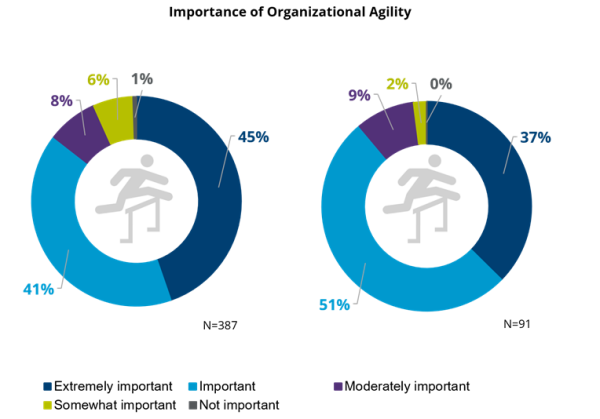
The last year has pushed organizations and required they quickly triage their business and adapt to an environment fraught with uncertainty and the unexpected. All of which emphasized the need for organizational agility. Hence, it’s not surprising that organizational agility is just as if not more important as it was 6 years ago, the last time we conducted this Organizational Agility and Strategic Planning Survey study.
Are We More Agile?
Not only has the need for organizational agility grown over the last six years, but organizations have also made steady improvements in both strategic responsiveness and organizational flexibility.
While strides have been made towards agility, organizations still face key impediments:
- Wedded to the Annual Cycle—most organizations are still beholden to the annual planning cycle and rely on budget-based planning. This means organizations are much slower to recognize changes and recalibrate their initiatives. This is compounded by the fact that budgets and their limitations set what is feasible in the name of risk aversion.
- Struggle for Flexibility—organizations tend to excel at strategic responsiveness and developing strategies and lag in flexibility and effective implementation. Implementation practices and the inability to adjust project plans continue to hamper organizations ability to shift execution rapidly.
- Lack of Real-time Insights—the frequency of assessments to support the planning process and decision making are on the decrease. Analysis tends to align with the planning cycle and monthly and quarterly implementation reviews. To stay cognizant of changes that could be meaningful organizations need to combine real-time analytics with means to evaluate and prioritize the impact of trends.
However, it’s not all doom and gloom. Organizations are also baking in practices that help them stay alert and improve flexibility.
- Augment the Annual Cycle—while annual planning cycle is still the norm, many organizations integrate quarterly rolling plans to the cycle. The rolling approach balances long-term strategy with the ability to reassess and adjust accordingly to changes in the organization, priorities, and the business environment.
- Role for Process—organizations are including process performance as part of their planning assessments. This means that strategy and process reenforce and support one another. Process performance helps identify gaps and strengths, while being guided by the organization’s goals.
- Move Beyond SWOT—while SWOT is still vital for planning it has been supplanted by risk analysis. Organizations have become wary and reprioritized the impact risk has in developing long-term plans and preparing for uncertainty.
- Context for Data and Decisions—almost half of organizations use benchmarking in their planning process to identify new ways of working and provide context for performance and goal setting.
- Broad Mix of Trend Inputs—though market, customer, and competition are still the predominant external factors assessed for planning, there is a marked increase in assessing social, political, and environmental trends. These factors play a vital role in shaping customer needs and business environment risks and opportunities.
Overall organizations have both remained hampered in some ways and taken steps to ensure greater organizational agility. For example, while organizations’ planning methods have remained consistent—mix of budget driven plans and balance scorecards—there was also a marked increase in the number of organizations that conduct scenario planning. Showing that while organizations continue to rely on their tried and true approaches some are enhancing their methods to avoid being reactive and are prepared for the unexpected.
For more information check out Strategic Planning and Organization Agility: Survey Summary Report.
For more process and performance management research and insights, follow me on twitter at @hlykehogland or connect with me on LinkedIn.