The APQC Blog
All Posts
Social links
How EPM2 Creates Value and Reduces Planning Costs
In this short You Tube video, Dean Sorensen explains in simple terms the incremental business capabilities provided by the next generation of enterprise performance management (EPM), which he calls EPM2. These capabilities enable organizations to achieve financial, operational, and strategic objectives that are often undermined by fragmented and siloed planning models and processes.
What Is KM Maturity and Why Does It Matter?
In a recent thread in a knowledge management discussion group, I was embroiled in a KM maturity conversation (okay, truth be told, I embroiled myself—but I couldn’t help it). The initial post was innocent enough, something about existing maturity models. Since APQC has its own Levels of KM Maturity and an associated KM Capability Assessment Tool, initially I decided simply to lurk and not to extol the virtues of our model, which was created with significant subject matter expertise from a variety of sources.
The "Secrets" of Leadership Development
APQC recently spoke with Dan McCarthy, the Director of Executive Development Programs at the Paul College of Business and Economics, at the University of New Hampshire (UNH). He’s the author of the award winning leadership development blog “Great Leadership” and the Great Leadership Development and Succession Planning eBook.
Leveraging Your Technical Expertise: Three Knowledge Gaps between Experts and Mid-Career Employees
I would like to share some intriguing findings from a hot new APQC research project: turning the shortage of experts in scientific, technical, and engineering specialties on its ear and asking how organizations can leverage the experts they have. This is the first in a series of posts about our findings.
Knowledge Management Spotlight: A Conversation About Boundaries
In part one of our interview with Alice MacGillivray, she talks about boundaries, leadership, and use of edge-effect.
Alice MacGillivray, Ph.D., is a management consultant who works at the intersection of knowledge management, complexity, and leadership. Alice co-designed and directed the first MA in knowledge management and has published and presented at international conferences on KM and leadership topics.

Speedy Financial Closers Continuously Improve by Aligning Process and Technology
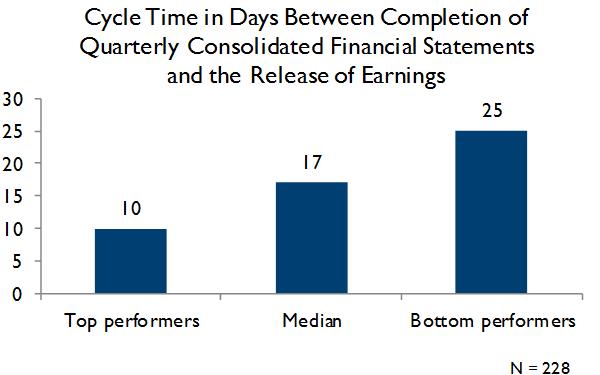
In the chart below, we see that companies that prepare and file their quarterly statements in 10 or fewer days are top performers. Accounting close expert Gabe Zubizarreta presents an interesting nuance to this information: the very fastest companies actually spend 50 percent less than their bottom-performing counterparts.
Content Management: What Works?
Back in January, you told us that content management is a key focus for 2014. Right now, APQC is conducting research to find out what organizations are doing to improve access to content and which tools and approaches are most effective. Please take our short survey by March 3 to help us determine trends and benchmarks in this rapidly changing field. Everyone who participates will receive a complimentary report summarizing the results.
5 Ways to Improve Supply Chain Logistics
Today executives are examining the logistics function as a strategic opportunity for process improvement, cost savings, and increased customer satisfaction. APQC created our popular Logistics Tune-Up Diagnostic and Interactive Logistics Tune-Up Diagnostic to help organizations find out if its logistics function is running smoothly.
Knowledge Management Spotlight: Transferring Critical Knowledge in a Crisis
APQC recently interviewed Jack Vinson on a wide range of topics regarding transferring critical knowledge. In part two of our interview, Jack discusses the challenge of transferring and using critical knowledge during a crisis. In part one, he talked about why identifying critical knowledge can be a difficult collaboration between management and workers.
Process Improvement Spotlight: How Intel used Six Sigma to Optimize Corporate Finance Processes
Intel Finance needed to standardize and optimize their corporate finance processes. Joe Pokorski, Intel's Manager of Business Process Improvement, explains role of Lean Six Sigma to drive the standardization and optimization of the processes and the development and transition to using BPM to truly manage processes.