The four key types of benchmarking organizations should perform are internal, external, performance, and practice. Benchmarking is an approach an organization uses to measure its internal processes and look externally (outside the function or the organization) to identify, understand, and adapt practices used by best-in-class organizations.
This blog highlights the benefits of benchmarking as well as how each type of benchmarking can benefit the organization.
The Value of Benchmarking
Organizations today are looking for ways to be more efficient, more effective, and more productive. It’s hard to learn new ways of working without looking to others—within your function, within your organization, within your industry, and those outside your normal “circle”.
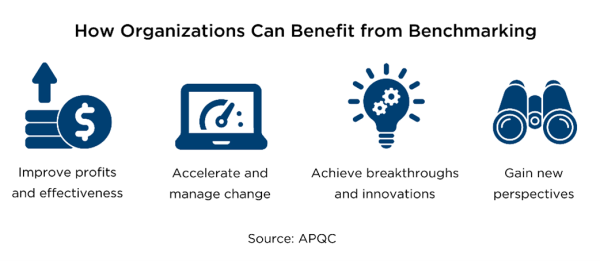
APQC research has found that organizations who benchmark are able to:
- Improve profits and effectiveness
- Accelerate and manage change
- Achieve breakthroughs and innovations
- Gain new perspectives
Benchmarking helps to accelerate innovation and change.
Four Key Types of Benchmarking
There are several types of benchmarking organizations can perform. Each type uses the same methodology (Plan, Collect, Analyze, Adapt) but collects different types of information.
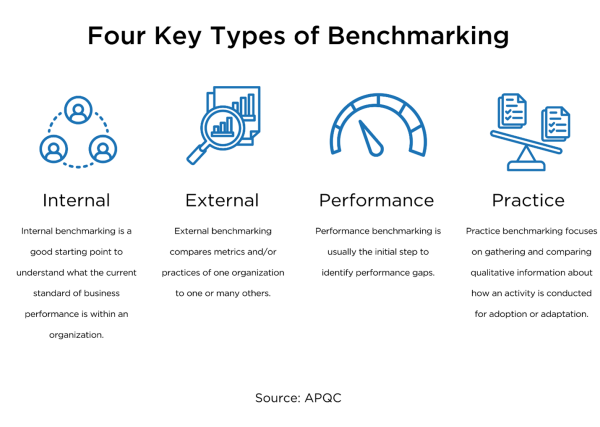
Here are four key types of benchmarking to consider, and what they provide for organizations who conduct them.
Internal Benchmarking
Internal benchmarking is a good starting point to understand what the current standard of business performance is within an organization.
- What You Need: At least two areas within the organization that have shared metrics and/or practices.
- What You Get: Internal benchmarking is a good starting point to understand the current standard of business performance. Sustained internal benchmarking applies typically to large organizations where one or more areas of the business are more efficient than others.
External Benchmarking
External benchmarking compares metrics and/or practices of one organization to one or many others.
- What You Need: For custom benchmarking, you need one or more organizations to agree to participate. You may also need a third party to facilitate data collection. This approach can be highly valuable but often requires significant time and effort.
- What You Get: An objective understanding of your organization’s current state and standardized language, processes, or measures which enable you to set baselines and goals for improvement.
Performance Benchmarking
Performance benchmarking is usually the initial step to identify performance gaps.
- What You Need: Standard measures and/or KPIs and a means of extracting, collecting, and analyzing that data.
- What You Get: Data that informs decision making around the execution of a process or activity, content for establishing and tracking goals, and prioritizing improvement opportunities.
Practice Benchmarking
Practice benchmarking focuses on gathering and comparing qualitative information about how an activity is conducted (e.g., types of IT systems, training for staff, resources, business rules, or processes) for adoption or adaptation.
- What You Need: A standard approach to gather and compare qualitative information such as process mapping, interview guides, or survey instruments.
- What You Get: Insight into where and how performance gaps occur and best practices that the organization can apply to other areas.
In Conclusion
Change is inevitable. Organizations that embrace change and excel through it are those that benchmark to systematically identify and transfer best practices into their business.
Get started today with APQC’s Benchmarking Basics Collection. This collection includes templates, tools, a glossary, APQC's Process Classification Framework (PCF)®, Benchmarking Code of Conduct, and articles that explain the steps required for successful benchmarking.
Explore these additional APQC Benchmarking resources: