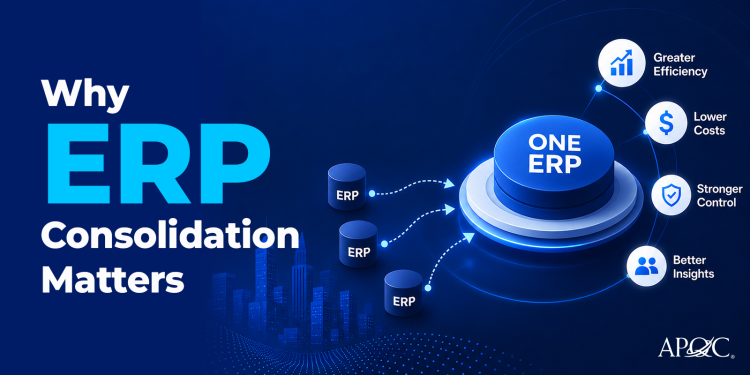
ERP consolidation is becoming a finance priority for organizations looking to simplify finance and operations. But as companies grow, acquire businesses, and expand globally, they often end up with multiple ERP platforms. Instead of creating clarity, this ERP sprawl can increase costs, fragment data, slow reporting, and force finance teams into manual workarounds.
ERP consolidation is more than a technology project. It is a way to improve finance performance, strengthen decision-making, and create a cleaner foundation for automation and AI. APQC benchmark data shows that finance shared services organizations operate a median of 3.0 ERP systems or instances. That makes consolidation a high-value opportunity.
Why ERP Consolidation Matters
Every additional ERP adds complexity. Finance teams must reconcile more data, maintain more integrations, and manage more reporting variations before leaders can trust the numbers. Over time, those extra steps create hidden costs and slow the finance function.
A strong ERP consolidation business case should evaluate:
Licensing, maintenance, and IT support costs across each platform
Hidden costs from integration workarounds, delayed closes, and slower reporting
One-time costs for migration, implementation, training, and change management
The goal is not simply fewer systems. The goal is a more agile finance function that delivers timely, reliable insight.
How CFOs Can Move Toward Fewer ERPs
ERP consolidation does not always mean moving every business unit onto one platform immediately. Separate systems may be needed for regional compliance or specialized acquired businesses. Still, CFOs can reduce complexity by standardizing processes, improving data quality, and using technology strategically.
Finance leaders should focus on:
Standardizing data definitions and reporting practices across systems
Strengthening data governance before investing heavily in automation
Using cloud ERP, RPA, and AI as enablers of simplification, not substitutes for it
Reviewing the consolidation business case regularly as technology evolves
Migrating fragmented systems to the cloud without streamlining processes only moves complexity to a newer environment. Real progress comes from intentional simplification.
For a deeper look at how finance leaders can reduce ERP complexity, explore APQC's report on four practical steps to move toward ERP consolidation.
ERP consolidation helps finance reduce costs, accelerate reporting, and strengthen data confidence.