A business process owner is an individual responsible for the end-to-end success of a specific business process, ensuring it meets its objectives and aligns with the company's overall goals.
It is important that organizations designate an owner for each core process. Consider an orchestra with no conductor. You may have many talented musicians, but no one leading the group results in chaos. A conductor harmonizes the noise of an orchestra, much like a process owner harmonizes the efforts of a process.
Expanding on this analogy, let’s talk about some of the core roles a conductor plays and how it relates to process ownership.
- Set the Tempo and Vision – Like a conductor sets the tempo and guides the musicians through a production, process owners set the tempo and vision of a process by assigning the metrics that will be used to gauge the success bringing process workers together working toward a common goal.
- Cue the Right Parts at the Right Time – Similar to when a conductor cues the woodwinds or the brass to join the production, a process owner truly owns the process and coordinates the process, ensuring each process worker steps in at the right time, and handoffs go smoothly.
- Maintain Cohesion and Synchronization – Just like when a conductor advises different sections of the orchestra to play at different volumes, a process owner can mitigate conflict or harmonize the “noise” that can sometimes appear from cross-functional work. Having a process owner that has the right authority, and skillsets to mitigate conflict in a positive way is crucial to success.
Key Responsibilities and Skillsets for Business Process Owners
The roles above speak at a high level about how process owners “play their part”. Let’s dig into the day-to-day responsibilities and skills process owners should have:
Key Responsibilities
- Define the process
- Manage documentation
- Set performance targets
- Monitor and report on performance measures
- Assess and improve process maturity
- Identify risks, roadblocks, and improvement opportunities
Key Skillsets
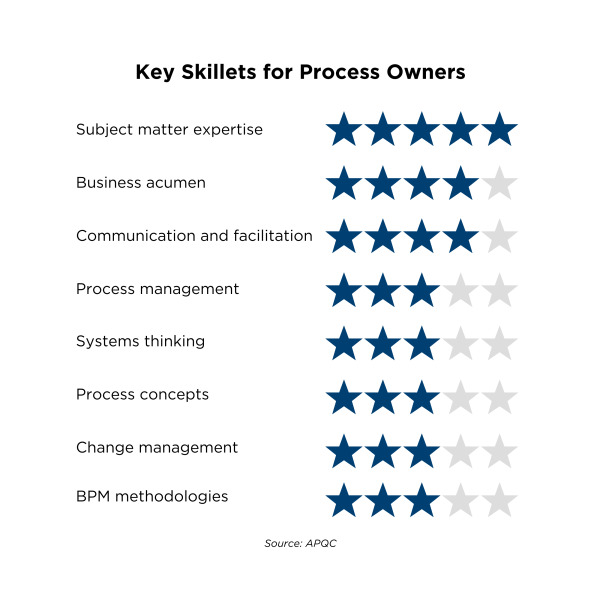
Organizations that are committed to process excellence know they can’t stick just anyone in a process governance role—it takes people with subject matter expertise, business acumen, and a passion for process to govern effectively.
Identifying what sections you need for the orchestra is only part of the process; choosing the right conductor is essential to harmonize everything together. One key component of process governance is getting buy-in and coordinating process work at the enterprise level. Without the proper buy-in, process work can become siloed and disjointed. APQC recommends the following to drive success:
- Process owners should exhibit deep expertise and enthusiasm for the process.
- Look for individuals who are already accountable for the performance of the process.
- Process owners should be able to create buy-in and accountability.
- Managers are a good place to start when looking for process owners, but other long-tenured and expert employees should also be considered.
- Consider a cross-functional group of leaders, or a steering committee, that can provide oversight and governance for process work, prioritize opportunities, and align processes and process work with organizational strategy and objectives.
To learn more about process governance, and process ownership, view these resources:
- Common Process Management Roles
- What Is Process Governance?
- Designing Process Is Easy, Governing Is Harder
- Applying Governance and Roles to End-to-End Processes