Articles
|
March 10, 2026
How to Address the Top Process and Performance Management Challenges for 2026
c: 1785731233
In our annual Process and Performance Management Priorities research, APQC surveyed 156 process and performance management professionals to identify common challenges and priorities for 2026. We found that process management and continuous improvement are the primary areas of focus for this year. In this article, you will learn about the top priorities within these two focus areas and tips for tackling them.
Process Management Priorities
Process management, or business process management (BPM), is a broad set of management approaches that encompass process redesign and innovation, process sourcing, and process improvement. APQC’s 2026 survey found that process professionals are continuing to focus on end-to-end process mapping, moving from a function-based to a process-thinking culture, and improving the maturity level of process management practices (Figure 1).
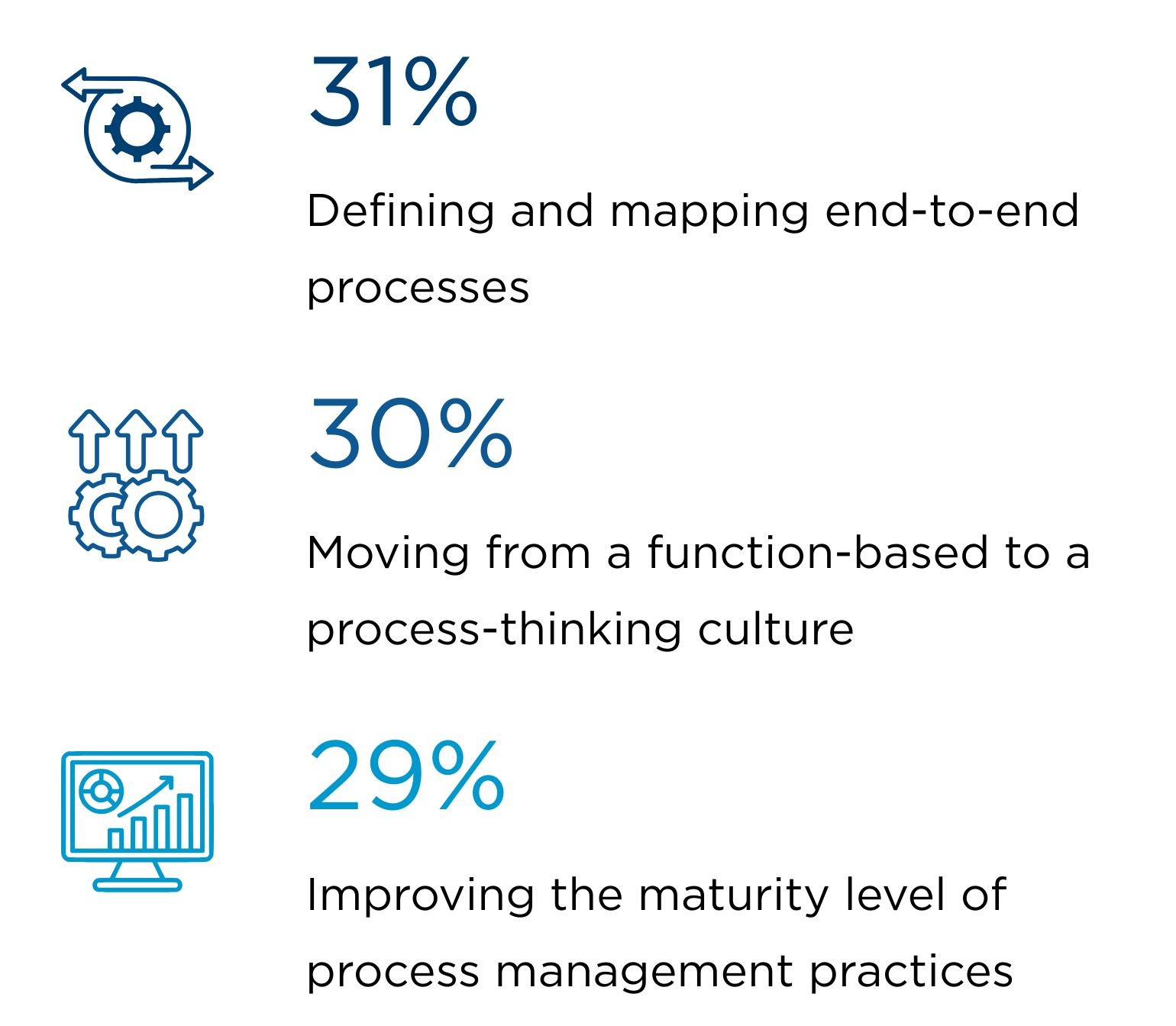
Fig. 1
Looking at how the data has trended over the past few years, we see a sustained shift from function-based to a process-thinking mindset that connects work across the value chain and ties it directly to business outcomes.
Defining and Mapping End-to-End Processes
End-to-end process development has been the top process management priority year-over-year. This sustained focus reflects the value of viewing work across the full value chain rather than through a functional lens. End-to-end processes provide greater visibility into customer experience, scalability, and productivity, while improving handoffs and clarifying how changes in one step affect upstream and downstream stakeholders.
To move towards a end-to-end process mindset, organizations need to define, align, and govern their processes.
Most organizations cannot address every end-to-end process simultaneously. Instead, focus on the initiatives that will deliver the greatest value based on strategic priorities and business objectives. In some cases, this may mean beginning with lower-level processes that support broader end-to-end outcomes. Regardless of scope, efforts should be clearly tied to measurable business results.
Organizations can also leverage existing process maps and frameworks to refine scope and sequencing. These resources help teams avoid starting from scratch and enable a more structured approach to prioritization. For additional guidance, see APQC’s End-to-End Process Maps and Measures collection, Applying End-to-End Processes collection, and Creating End-to-End Processes: How to Use a Process Classification Framework.
Moving from a Function-Based to Process-Thinking Culture
After declining in importance in 2024 and 2025, building a process-thinking culture has reemerged as a leading priority. A process-thinking culture shifts the focus from optimizing individual functions to understanding how work connects across the value stream to deliver business outcomes. This mindset fosters shared ownership, cross-functional collaboration, and more consistent decision making.
As illustrated in this approach to scaling process thinking, success depends on simplifying methods and language, embedding practical tools, and empowering employees to improve their own work rather than positioning process as the responsibility of a central team. Ultimately, the goal is to move from “the process team owns process” to “the business owns process.” This shift is less about documentation and more about enabling better decisions, accelerating improvement, and reinforcing accountability across end-to-end processes. Improving the Maturity Level of Process Management Practices
Improving the maturity of process management practices remains a foundational priority for organizations seeking to scale impact and enable digital transformation. Advancing process management maturity requires strengthening each of the seven tenets—strategic alignment, governance, process models, change management, process performance, process improvement, and tools and technology—so that process management becomes embedded in how the organization plans, executes, and improves work.
Organizations with more mature programs are more likely to cultivate a process-thinking culture and manage work from an end-to-end perspective, as higher maturity levels integrate process with strategy, clarify accountability, and connect processes across functional boundaries. Explore this report to discover best practices organizations can use to improve their process management maturity by strengthening each core tenet of process management. Continuous Improvement Priorities
Continuous improvement is an enduring area of focus for process teams. Organizations often struggle to achieve more than a few one-off improvements. Thus, process teams are focused on building continuous improvement cultures, creating a systematic approach for identifying improvement opportunities, and aligning efforts across the enterprise (Figure 2).
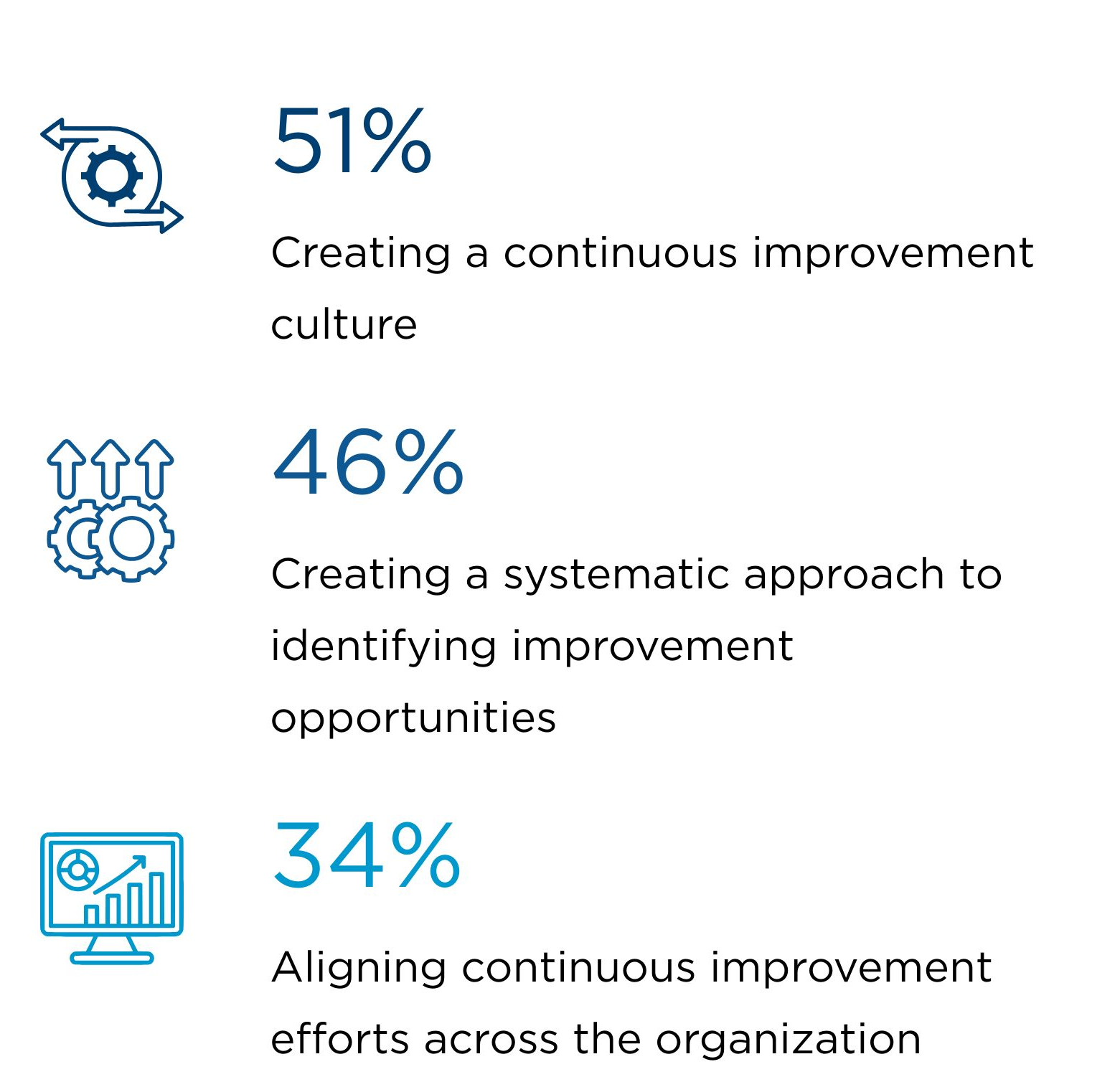
Creating a Culture of Continuous Improvement
Much like process thinking, continuous improvement works best when it’s a “culture.” Even the largest and most well-equipped process team can’t spot all improvement opportunities across the business. It’s better to ensure your employees have the skills, tools, and decision rights to identify opportunities on their own, in the flow of their work. This keeps improvement efforts organic and helps optimize the business.
Building a continuous improvement culture is generally harder than building a process-thinking culture. A process-thinking culture can safely grow within a few pockets of an organization, even if function-focused mindsets are predominant elsewhere. But continuous improvement efforts tend to draw more attention, and they can be easily stomped out by a few vocal detractors. Thus, APQC recommends approaching continuous improvement with a robust change management plan that clearly spells out the purpose and value of the change.
Creating a Systematic Approach to Identifying Improvement Opportunities
In the past few years, we have found that process teams aren’t struggling as much with prioritizing process improvement opportunities—instead, the biggest challenge is identifying improvement opportunities in the first place.
Even the best process teams can’t spot all improvement opportunities. In addition to creating a culture where employees are empowered to identify opportunities, process teams need to build feedback loops with key stakeholders and take advantage of data to find the most fruitful opportunities. Approaching improvement opportunities systematically can lead to efficiencies, cost-savings, and greater employee buy-in and engagement.
Aligning Continuous Improvement Efforts Across the Organization
Siloed continuous improvement efforts sometimes do more harm than good, as the organization optimizes one area of the business at the expense of another. Thus, process teams are seeking to align continuous improvement efforts across the organization. The best way to do this is through an enterprise-wide portfolio that provides consistency and a holistic view.
Collaborate to Identify and Prioritize Improvements
To better manage process management and continuous improvement work, APQC recommends that process teams take lessons from their peers in project management.
Use a portfolio approach to evaluate, prioritize, and manage process and continuous improvement projects. Establish pre-set criteria around value, complexity, and risk to ensure you’re working on the right opportunities. Ideally, criteria should be established with support from a steering committee who will then provide ongoing guidance and oversight.
Once projects have been evaluated and categorized, process teams should work with a steering/review committee comprised of relevant stakeholders to:
- Assess them comparatively
- Prioritize them based on criteria and open discussion
- Determine which should enter the portfolio and get resources
- Rank them based on priority and available resources
To ensure you have a steady pipeline of projects flowing into the portfolio, APQC recommends three approaches.
- Engage employees to “crowdsource” opportunities
- Leverage process stewards and process owners to pinpoint opportunities as part of their roles
- Use process KPIs and measures to identify opportunities based on pre-set tolerance ranges and regular reporting
Key Takeaways
For 2026, process teams have consistent priorities for process and performance management:
- There is an emphasis on “culture of” to drive key behaviors and norms.
- End-to-end work remains a high priority.
- Having a strong process management foundation is becoming even more critical.
Additionally, staying relevant requires moving beyond process, performance, and change selectively and focusing on business outcomes. Enabling and sustaining change is the number one critical success factor.
About this Content
This content can include median values sourced from APQC's Open Standards Benchmarking database. If you're interested in having access to the 25th and 75th percentiles or additional metrics, including various peer group cuts, they are either available through a benchmark license or the Benchmarks on Demand tool depending on your organization's membership type.
APQC's Resource Library content leverages data from multiple sources. The Open Standards Benchmark repository is updated on a nightly cadence, whereas other data sources have differing schedules. To provide as much transparency as possible, APQC will always attempt to provide context for the data included in our content and leverage the most up-to-date data available at the time of publication.
Contents
c: 1785731233