The consulting profession’s largest firms--the multi-billion dollar global firms that offer services across multiple industries, geographies, and market segments--have brand awareness levels as much as twice that of the average firm. However, the relative likelihood that a client will hire them isn’t that much better than the masses of smaller, niche-focused firms.
That’s the surprising takeaway from a focus group of 20 buyers of consulting services when asked about their perceptions of more than 70 leading consulting firms. Buyers (comprised of C-level executives as well as procurement professionals) were asked to rate their awareness of firms on a scale of 1 (low) to 5 (high). The average of the 73-firm sample was 2.1 while those of the six largest multi-service firms ranged from 3.5 to 4.2.
The fact that larger firms have higher awareness levels isn’t a surprise. It can be explained, in part, by the fact that these firms offer strategy/operations, financial advisory, HR, and IT consulting, making it far more likely that clients have had some interaction over the years vs. those firms just focused on one of those segments. And certainly part of the higher awareness numbers can be attributed to the massive marketing budgets of these firms; many have sponsored golf tournaments, obtained celebrity endorsements, and undertaken massive ad buys.
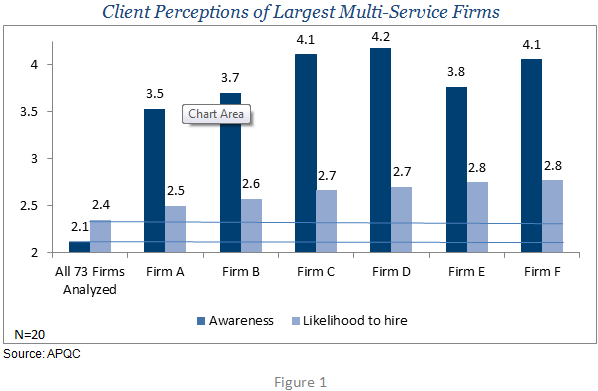
What is surprising is that brand awareness doesn’t necessarily equate to a significant advantage in winning more work. Buyers of consulting services were also asked to rate (on the same scale of 1 to 5) how likely they were to hire a specific firm. Among all 73 firms analyzed, the average score was 2.4–just a tad lower than the six global multi-service firms, whose scores ranged from 2.5 to 2.8.
Why Bigger Isn’t Better
Why aren’t the large multi-service firms better positioned to leverage their brand awareness to win a larger share of engagements? It’s largely because brand and size aren’t differentiators any more. When APQC presented 17 different selection criteria to a group of 46 buyers of consulting services in an online survey conducted in the first half of 2012, firm size was rated the least important. Clients were clear in their preference for experience at a competitive price.
Smaller, highly specialized firms are arguably better positioned than larger firms to argue that they have more experience in the one area in which they’ve focused vs. larger firms that may do a multitude of things really well. Moreover, smaller firms tend to have lower overhead expenses and therefore can be highly cost competitive. And local firms can charge as much as 10 to 15 percent less (even if their hourly rates are the same) because they have no pass-through travel expenses.
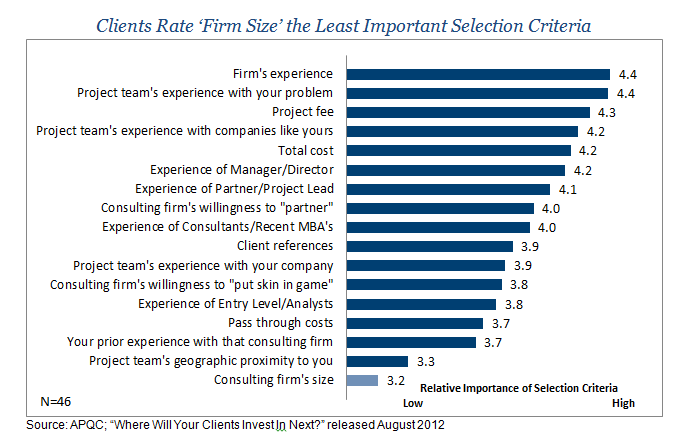
Figure 2
The Hidden Opportunities
A decade ago, brands mattered more. Size was a sign of stability. Today, size is the least important attribute. However, that isn’t to say size doesn’t matter at all. The key for large firms is to reposition their size as an advantage.
Clients aren’t buying as many massive, enterprise-wide projects as they previously have, so it doesn’t really matter if you employ 10,000-plus consultants. Clients are often only looking to hire the best five consultants, so there’s no reason to stress the other 9,995 consultants they aren’t hiring for a given project. Instead, take this opportunity to better leverage the expertise of your world-class experts and find ways to add greater flexibility to your staffing process to more consistently put together the best possible teams together.
Perhaps more importantly for long-term success, large firms can offer far more robust career tracks and training opportunities than smaller firms. Don’t take that for granted. Use those advantages to attract the best and brightest and stress their expertise to clients. At the end of the day, the quality of your people is the best source of differentiation.