This time of year marks the beginning of the dreaded budgeting season for many finance organizations. The drill requires organizations to go through a ham-fisted process that has business unit managers guessing at revenue growth, costs, and spending patterns for 2014. But today’s finance leaders are growing wary of performing this exercise when they know its applicability will grow stale fast. Specifically, they are getting tired of having to reconfigure the original plan every time a business condition emerges that voids original budget assumptions. According to an article by InsightSoftware.com’s Jon Louvar, continuous budgeting is a better methodology for performance management because it saves labor hours and improves forecasting accuracy.[1] With that in mind, APQC presents the top four reasons to make the traditional annual budget dance more efficient (if you cannot simply ditch it outright):
- Less preparation time and costs
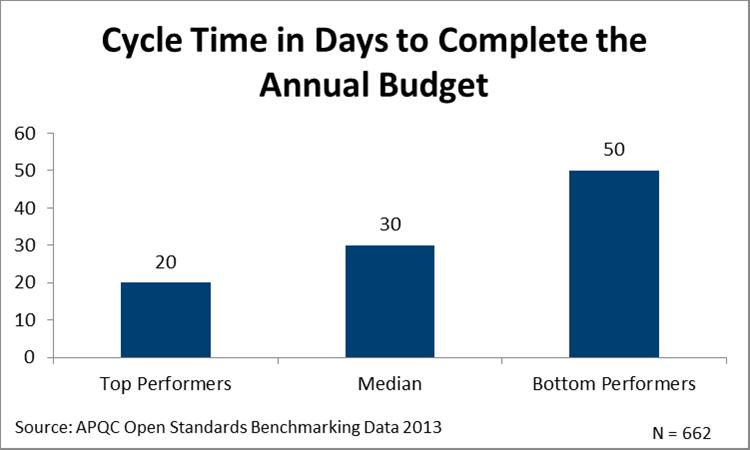
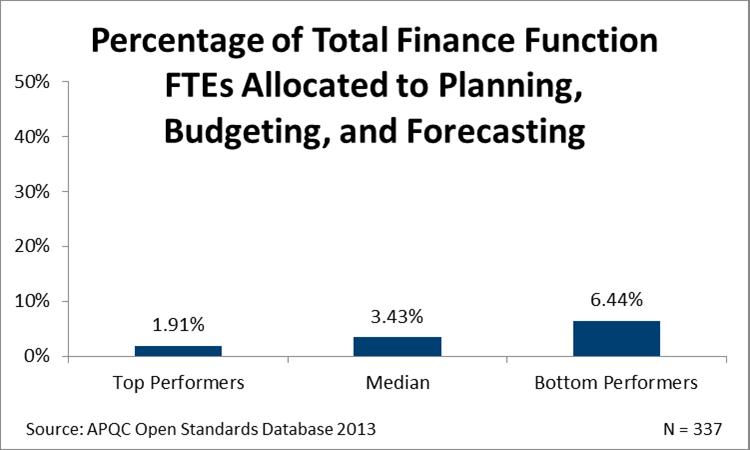
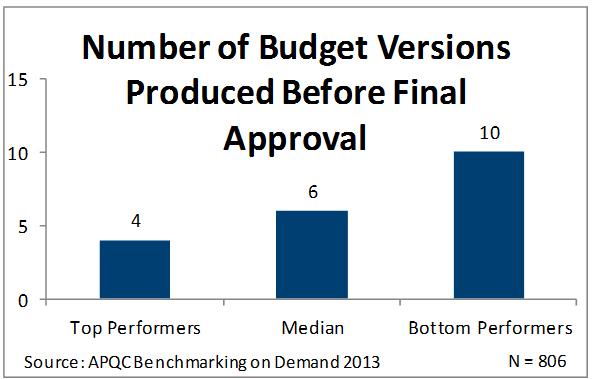
- Sending budgeting documents back and forth between finance, sales, marketing, product management, etc. means more time and labor costs. The longer the budgeting process, the more FTEs are needed and the higher the cost of budgeting becomes (see graphs below). The difference between top and bottom-performing organizations in cycle time and total costs of planning and budgeting support the decision to move to continuous budgeting.
- Reduction in wasted resources
- Organizations that are rewarded by staying within predetermined guidelines will often attempt to use up the resources budgeted—even if those resources are not necessary—in order to keep the same amount of money in the budget for next year. With continuous budgeting, organizations spend only what is needed.
- Better, more current information
- Organizations using annual budgets are looking at historical patterns and years-old data to predict what the organization will need in the future. By meeting quarterly or monthly, management can use real-time data and current market conditions to make current, more informed decisions rather than fuzzy predictions.
- No more rearranging predetermined resource allotments
- When faced with fast-moving external market conditions or internal changes by finance or other business units, finance managers no longer have to rearrange a settled budget—decided months earlier—in order to shift resources around. By reevaluating every month or quarter, resources are more precisely decided and the budget is continued rather than overhauled, saving time, stress, and costs to the organization.
When business units collaborate more than once annually to determine upcoming budgets, the response to real-time scenarios reflects a more accurate picture of the organization’s available financial resources and the best opportunities for deploying those resources. Organizations are able to realign their goals to better suit the realities of their environment.
[1] Jon Louvar. "Continuous, Not Annual, Budgeting Improves Accuracy." CFO, June 17, 2013.