During the recession, many companies pared their supplier lists to win volume price discounts from surviving vendors. Many firms also extended the global reach of their sourcing activities. But the need to balance cost efficiency with supply chain resiliency has become a growing concern. APQC’s survey of organizations that are managing the risk of supply chain disruptions shows that most organizations are aware of the risks that extreme weather disruptions, political turmoil, and natural disasters pose to business continuity.
According to Russ Banham at CFO Magazine, organizations are taking measures to mitigate this risk. Supply chain localization is one promising trend. One benefit of shorter supply chains is that there is more flexibility to change orders in transit should an emergency situation arise.
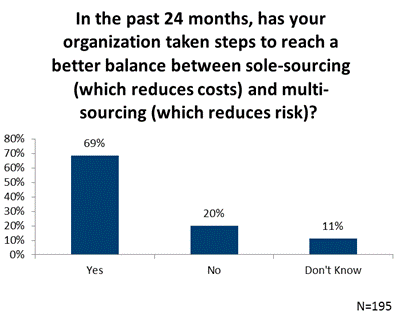
One important practice that organizations must employ when it comes to supply chain management is balancing risk and cost effectiveness of global and sole-sourcing suppliers. APQC’s survey found that 69 percent of organizations are already taking steps to do just this.
Another necessary step is to include redundant suppliers. When things are running normally, an organization is able to accrue safety stock; in the event of an emergency, such as a tsunami, political upheaval, etc., the organization can assess the impact on suppliers quickly and use the safety stock while waiting for the redundant suppliers outside the affected region to expedite supplies.
One organization has stood out as a great example of balancing risk and cost effectiveness is Baker Hughes. Both Supply Chain World and Supply Chain Brain have written about this organization’s supply chain strategy, a hub-and-spoke system comprised of local and global suppliers.
APQC is hosting a joint FM and SCM webinar on June 19th. A panel of experts, including Mike Miedema of Baker Hughes and John Hejka and Eric Gerner of Experis, will provide advice on how to:
- identify and quantify supply chain disruption risk that stems from geographic and political worries,
- assess whether you need more capital investment in safety stock, and
- develop sound risk mitigation strategies that reach beyond Tier-One suppliers.
This webinar is now over, please see the slides and recording for more information.