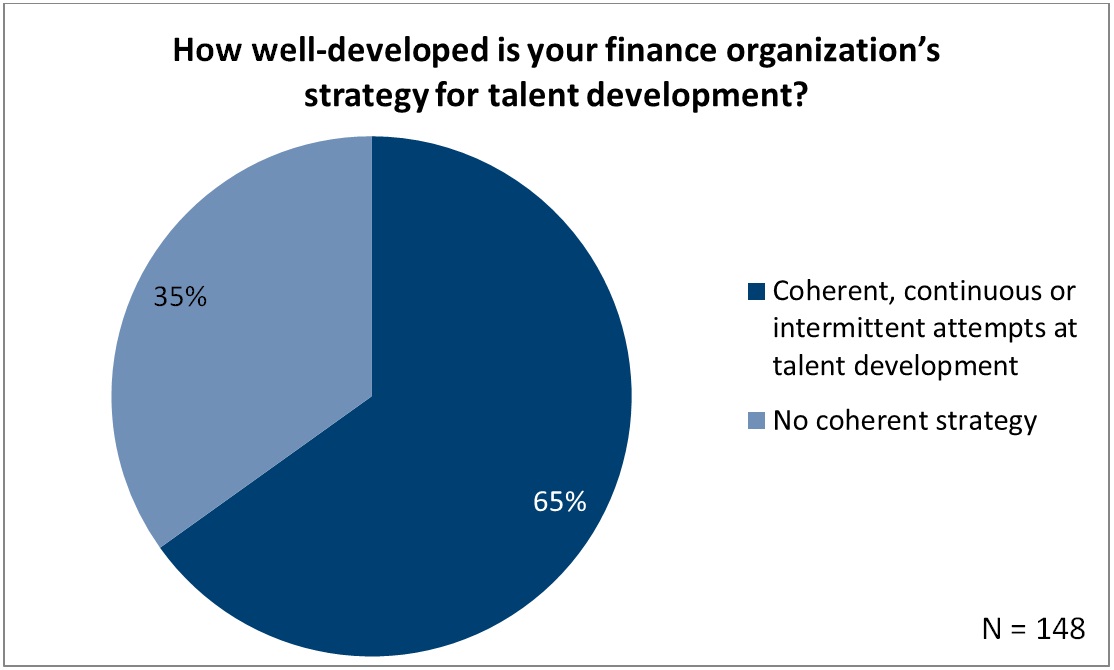
In a survey conducted in March 2012 by APQC and IEG, 65 percent of finance organizations have some strategy for talent development, either with a coherent, continuous strategy or intermittent attempts. However, an alarming 52 percent of those same respondents who are making an effort to develop talent believe they will suffer from talent flight once the economy truly picks up.
Click here to access a free download of APQC’s research summary.
So what gives? Why are so many finance professionals expected to seek employment elsewhere when the economy heats up? How can organizations improve their talent development programs to retain employees?
One particularly successful program includes giving finance operations people exposure to a broad range of challenges, skill sets, and practical business acumen. In order to achieve this, Intel Corporation encourages all finance employees to rotate through different roles throughout their careers with each rotation period lasting from 18 to 36 months. The rotation program provides both breadth to the employee and new perspectives to the organization.
Click here to read the full case study on Intel Corporation.
A variation of this kind of rotational program, implemented at Mutual of Omaha, is a development program in which newly hired graduates rotate around different financial areas so management can observe where talents lie. When there is an opening in a particular area of the finance function, managers initiate discussions with employees who are talented in that area to see whether they would like to be considered for the job.
Click here to read the full case study on Mutual of Omaha.
As finance organizations seek tech-savvy talent with more "soft skills" (e.g. critical thinking, problem solving, negotiation, communication, and collaboration), programs with a wide array of training opportunities in technical and soft skills will help with retention efforts. Training programs, both instructor-led and online courses, should cover a broad range of topics, from economics of the organization's industry to business partnering.
Also, a corporate-wide sabbatical program is a positive deterrent for financial talent to search elsewhere for employment.
In the end, an organization should aim to cultivate strong, well-rounded finance professionals who will want to stay with the company precisely because it offers diverse programs for developing a dynamic and rewarding career path. Though there is no one formula to ensure your organization retains talent, exploring a variety of innovative programs that best suit your culture and business needs is a smart move. The big losers will be the 35 percent of finance organizations that don’t have any coherent strategy for talent development at all.