Organizations around the world leverage APQC’s process classification framework (PCF) to efficiently define processes, benchmark performance, and catalog and organize knowledge and content. Organizations depend on APQC to consistently define and manage the PCF in order to ensure the long-term value of their investment in adopting the framework. But how does it work? And how does APQC develop and manage the PCF?
APQC structured the PCF as a hierarchical functional decomposition (HFD), where each process element is mutually exclusive and collectively exhaustive (MECE). HFD means that each function or process is subdivided into successively deeper levels of detail until nothing else can be identified. Imagine a graph in the form of a tree. The broad concept is at the top, and its components break into lower and lower levels of detail until it is fully described. This principle can be repeated ad-infintum, but in the case of the PCF, it goes until the fifth-level of decomposition (called the task level—shown in the image below). A classic example of this process is the biological classification scheme introduced ninth grade biology classes.
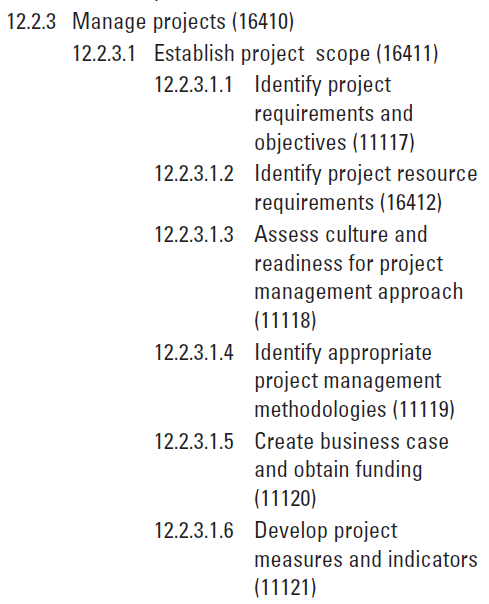
The process elements in the PCF are all uniquely identified by a five-digit process element identifier (shown in parentheses in the image above), which represents the conceptual definition of the process element. This number is reused across releases of the PCF including industry-specific releases. So if a process appears in the cross-industry and the retail PCF, that five-digit number is the same in both versions. This numbering scheme is intended to uniquely identify concepts addressed in the frameworks. It begins at 10000 and progresses upward from there, assigning new numbers to process elements as they are added to the database. (There is no specific logic to this process, other than first come, first served). The magic behind these numbers is how they enable things like benchmarking and traceability between systems and different versions of the PCF. So while hierarchical numbers—like “8.5.3” and “4.4” may change, these numbers stay with the process regardless of where it moves.
It is also important to note that every process element in the PCF must be mutually exclusive from every other process element while also being collectively exhaustive when considered as a set. Mutually exclusive process elements are those where there is no overlap with any other processes definitions. For example, consider the 12 level-one categories in the PCF. There is presently no overlap between these concepts: “Manage financial resources” does not overlap with any other category. Similarly, these categories are collectively exhaustive, meaning that from APQC’s perspective, they completely represent the functions performed at an organization at the highest level. This same pattern of removing overlaps between process elements and eliminating gaps between process elements is repeated throughout the PCF’s nearly 2,000 item process element catalog.
Using these features—MECE and HFD, APQC ensures the consistency and long-term viability of the PCF. Let me know if you have any questions!