In an earlier blog post, Genpact’s Susmita Kanjilal, assistant vice president, master data management practice, and Sandeep Singh, vice president, sourcing and procurement practice, described the benefits of a master data management program and potential obstacles to implementation. In this second half of APQC’s conversation with Kanjilal and Singh, they present a framework for implementing a master data management program.
Susmita Kanjilal and Sandeep Singh gave an in-depth presentation on this topic during a recent APQC webinar.
What resources would you recommend for organizations starting a master data management program?
We believe there are seven levers to the development of a master data management program that makes a material impact on a business (as shown in the figure below).
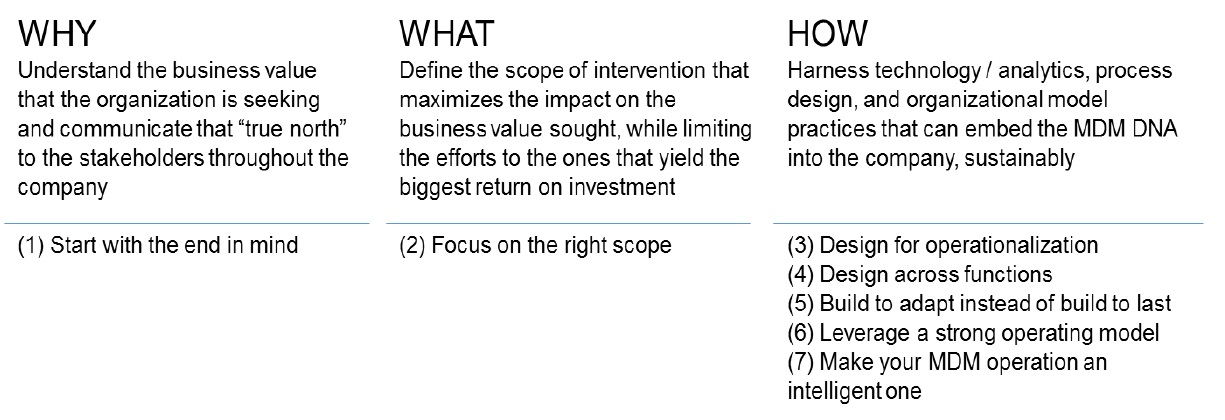
For organizations to start a master data management program it is essential to follow the seven levers:
- Start with the end in mind—Organizations should focus on master data management must-haves, which vary based on the organization’s priorities and industry. For example, companies focusing their efforts on cost reduction and compliance typically should concentrate on vendor, material, and finance master. Organizations focusing on revenue should hone in on customer master. At an industry level the strategic objectives will also vary; for example, commercial operations in pharmaceutical firms focus on customer master, which generates maximum savings through effective marketing. Consumer products/packaged goods companies focus on product data management to improve their capabilities to publish to a global data synchronization network, which enables trading partners to globally share trusted product data and ensures reduced penalties from incorrect product dimensions passed on to retailers.
- Focus on the right scope—It is very common for large, technology-driven efforts to get into trouble because of an overly ambitious scope. In the case of master data management, not all data is equal, and the master data management plan must reflect that. Data fields, systems of record, interfaces, business units, plants, and users vary in terms of the materiality of the impact they have on key business outcomes. For instance, a large pharmaceutical organization understood that it would achieve maximum business impact by focusing on procurement, in particular on spend analysis and supplier qualification/pre-qualification, and hence it prioritized underlying masters like vendor and material data.
- Design for operationalization—Most companies follow a traditional approach for designing, building, and operating master data management processes. Very often the artifacts created during the design phase do not take into consideration the operational feedback loop to get quick wins. Operationalization can start by addressing the quick wins that bolster the internal credibility of the effort, such as building a pragmatic catalog taxonomy to reduce free-text fields, standardizing and correcting the data dictionary, and gradually enhancing existing processes to ensure quick benefits.
In this way, companies don’t have to wait for a full-blown master data management program to get stabilized to increase their spend visibility and go after incremental savings. These companies can achieve good spend visibility by adopting the right material taxonomy, driving catalogue and purchase order penetration, and creating a proactive mechanism to convert, wherever possible, supplier contracts into useable catalogs. - Design across functions—Master data management is, by definition, an effort that connects finance, supply chain (whether physical or virtual), procurement, and other functions such as compliance and risk. Thus, a master data management initiative should be supported by a cross-functional steering committee.
- Build to adapt instead of build to last—Volatility of the business environment is a major factor in the need for agility. Such agility requires the ability to continuously tweak or downright build new parts of the solution. Achieving this agility requires the ability to design, build, and operate at the same time and out of the same group, and push the group to be more interdisciplinary.
- Leverage a strong operating model—Master data management is not an implementation—it is an operating structure that needs to complement other company functions. Master data is one of the newest functional developments in enterprise management and doesn’t “grow” without concerted effort. Advanced operating models leverage specialized end-to-end process design, like the examples discussed in the fourth lever. They also employ specific organizational models, such as governance structures, centers of excellence, and global business services and/or outsourcing.
- Make your master data management operation an intelligent one—The continuous learning that enterprise processes can produce is often lost due to fragmentation of systems and stakeholders. For example, understanding what data fields and which users are important for certain downstream business outcomes (e.g., anti-bribery or other risk management) is clearly enabled by the continuous comparison between what was done by who and what impact it had at the end of the process. A continuous loop of learning can enable the fine tuning of tools, practices, and processes upstream.
What are some of the insights and lessons learned from the implementation of a master data management program?
Our key master data management lessons include:
- Technology roadmaps are long and sometimes involve multiple years, but there are always quick wins that can be implemented up front to improve master data for the organization (e.g., adopting a standard data dictionary for material, guidelines on mandatory attributes for setting up various masters, etc.).
- Data governance (including setting up a formal organization with defined roles, responsibilities, and master data policies) should be an up-front effort. It should be established and followed diligently.
- Change management is another key component, in that organizations should be educated on the importance of master data and treat data as an asset.
- Process is a key component of any master data management initiative. Organizations should focus on standardizing processes with key controls embedded to improve the efficiency of the affected divisions (e.g., integrating the supplier onboarding process with the supplier risk management process helps both the finance and procurement divisions).
Though technology is a key component of establishing the right master data, not all of the effort should be spent in implementing the right technology. Data governance, the right operating model, processes, and data quality are equally important concepts on which organizations should focus.