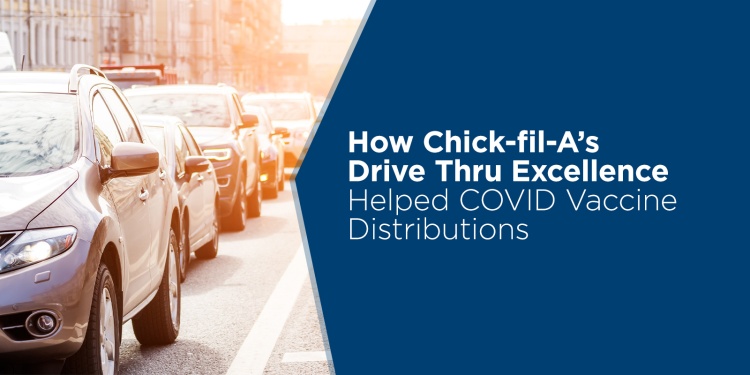
On January 22, the town of Mount Pleasant, South Carolina opened a drive-thru coronavirus vaccine clinic. Soon after the clinic opened, computer systems went down, and the lines grew longer and longer. With hundreds of people parked in their cars waiting for the vaccine, the town’s mayor knew he needed to call an expert. So he rang Jerry Walkowaik, the manager of a local Chick-fil-A.
Chick-fil-A knows how to run a drive-thru. The QSR Drive-Thru Performance Study, which analyzes drive-thru performance across the top fast-food chains, has ranked Chick-fil-A number-one overall six times. Chick-fil-A hasn’t always been the fastest (in fact, it actually had the slowest service time in QSR’s 2019 report before re-claiming the top spot in 2020). But customers always feel like they’re getting fast, friendly, and efficient service at Chick-fil-A, thanks to the company’s deep understanding of the drive-thru process and relentless focus on the customer experience.
When Chick-fil-A manager Jerry Walkowaik observed the situation at Mount Pleasant’s vaccine drive-thru, he knew just what to do. He noticed that only one person was checking people into the clinic. After enlisting a few additional volunteers, he quickly streamlined the process and reduced wait times from over an hour to just 15 minutes. “We saw a little hiccup in their drive-thru system and we needed some more people, so we gathered some of the wonderful Rotary volunteers and went down there and just was able to expedite the registration part,” Walkowaik told local news station WCBD.
The Power of Process
What happened in Mount Pleasant was made possible not just by Walkowaik’s kindness or the mayor’s quick thinking, but by the power of process. As Dr. Carla O’Dell has pointed out, a lack of end-to-end processes is one of the key reasons why the U.S. has struggled with vaccine distribution. APQC’s 2021 Process and Performance Management Priorities and Challenges survey also found that defining and mapping end-to-end processes is one of the biggest challenges that organizations are facing this year. Chick-fil-A has fully optimized the drive-thru process. How did they do it?
- Examine the process from end to end: Chick-fil-A uses full-scale mock drive-thrus at its Atlanta headquarters, complete with real cars, to assess and tweak each step of the process.
- Continuously gather stakeholder input: Many of the company’s drive-thru innovations were first developed by franchisees across the country.
- Use a balanced set of measures: Chick-fil-A does not maximize one measure (like speed), at the expense of others (like order accuracy).
- Never settle: Despite sitting atop QSR’s drive-thru performance ratings, Chick-fil-A continues to test and implement drive-thru innovations like an outside meal delivery system complete with magnetic delineators to keep customers and team members safe from Covid-19.
Apply this Lesson
Chick-fil-A’s drive-thru process knowledge is amazing, but importantly, it’s also organizationally and technologically agnostic. Walkowaik didn’t need any special Chick-fil-A tools or staff to fix the vaccine distribution drive thru; he simply applied his understanding of the end-to-end process. End to end value creation is a factor of stakeholder relationships with external parties—like fast-food customers or citizens in need of vaccines—not an organization’s internal hierarchy.
So, if you want to get started with improving your end-to-end processes, know that you don’t need to start from scratch. Use APQC’s End-to-End Process Maps and Measures to tackle large scale-issues in key processes like such as idea-to-market, order-to-cash, hire-to-retire, and more. This collection includes related key performance indicators and benchmarks for the most common end-to-end processes.