Organizations evolve over time as they expand into new markets and develop product lines to meet fast-moving consumer trends. However, as organizations become more complex, performance management processes and tools—implemented long before the business evolved to what it is today—may be obfuscating senior management’s view of performance trends, opportunities, and risks. APQC research shows that larger companies sport relatively slower cycle times when it comes to financial forecasting. Arguably, outdated performance management models are holding many of these large organizations back.
According to APQC’s Open Standards Benchmarking in planning and management accounting, large organizations with annual revenues over $1 billion from 5.8 days to 14.3 days longer than small organizations to prepare the financial forecast (Figure 1).
Cycle Time in Days to Perpare the Financial Forecast
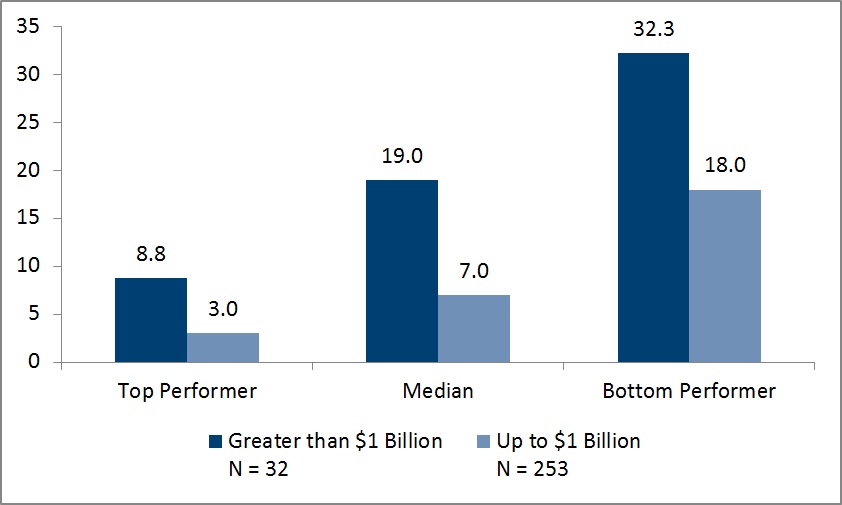
Figure 1
Chances are, they have to draw from multiple data sources, both financial and non-financial, to form a picture of future performance trends. Moreover, they may have to consolidate data from multiple operating units, a number of which may be using non-standard accounting systems or charts of account. Worse, they may be using performance modeling that relies on outdated cost assumptions. But there is change afoot. APQC’s recent best-practices research suggests that a growing number of large organization are no longer willing to tolerate sub-par performance management, particularly slow and inaccurate forecasting.
Earlier this month, APQC hosted its FM September community call on financial planning and accounting (FP&A). Dean Sorensen from Archetype Consulting discussed how even larger organizations can reduce budget cycle time while increasing forecast accuracy. In addition, Sorensen talked about:
- how mature processes can evolve to make finance a stronger business partner,
- how strategic, financial, and operational integration supports greater maturity,
- the differences between technologies that support increasing levels of maturity,
- how greater maturity can support breakthrough performance improvement, and
- specific value sources and self-funding improvement initiatives.
Download the slides or watch a recording of this on-demand webinar.