Automation of invoice processing, especially when electronic invoicing (e-invoicing) via EDI—a supplier portal—or network is involved, can save an organization 60 to 80 percent of its AP processing costs compared to its paper-laden predecessor. But less than a quarter of respondents to a recent survey by PayStream Advisors Inc. (PSA) are currently utilizing electronic invoicing.[1] Electronic invoicing adoption has been of keen interest among suppliers and the number of suppliers converting to electronic invoicing has increased. Today, suppliers send more invoices to companies in electronic format that do not require data entry, resulting in a more efficient and cost saving invoice process.
That is opportunity lost on several levels. E-invoicing not only reduces finance cost, it increases cost elasticity and can play a major role in improving the management of working capital. So why aren’t all finance management teams undergoing the process of automating as many processes as possible?
According to a 2013 report put out by Billentis, there are several barriers that organizations must overcome, and according to PSA’s recent report, these include shortage of IT resources, lack of sponsorship, lack of integration between e-invoicing and AP systems, and—as seen by a majority of respondents—suppliers that are not willing to adopt e-invoicing (Figure 1).
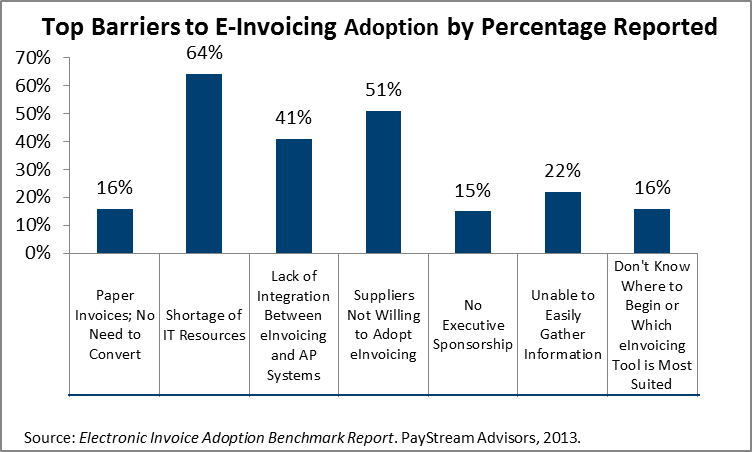
Figure 1
While financial thought leaders often look at the effects of automation barriers from the perspective of the barred organizations, it is also important to see the effect of stalled progress in e-invoicing on those enterprises that have already made the transition. Organizations that do use e-invoicing are unable to achieve full cost-savings if their suppliers do not support e-invoicing or do not currently have an e-invoicing or e-billing data set in place. Trading partners often need guidance and/or inspiration to transition to e-invoicing before actually committing to it, and large finance organizations use various methods to convince their trading partners to transition to automated invoicing (Figure 2).
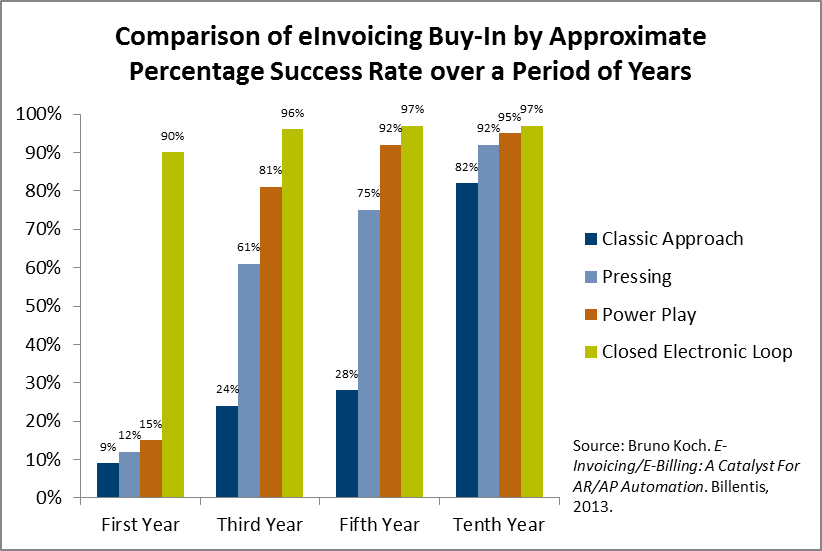
Figure 2
The traditional approach of large organizations pushing individual trading partners to send and receive invoices electronically has a success rate of only 20–30 percent over 2–6 years. “Pressing” fares better with a success rate of over 60 percent after the first three years and involves marketing heavily with partner organizations, as well as enhancing general contract terms which force trading partners toward e-invoicing. Power play takes pressing to another level by inflicting penalties for partner organizations that use paper invoices and is over 80 percent effective after the first three years of implementation. It is advisable, however, that organizations not attempt to pressure all suppliers to use the same data set and require just one certain format to follow its specific business process—the capabilities and requirements of suppliers can differ greatly.
By and large, the most (almost instantaneously) successful method for organizational cost-saving by invoice automation is the use of a closed electronic loop for purchase orders and invoices. PSA reports that 56 percent of survey respondents affirm that reduction in procedure-to-pay cycle time is the biggest benefit achieved from the usage of electronic invoicing, likely because this reduced cycle time leads to punctual payment of invoices, security of supplier discounts, and improved supplier relationships.
Regardless of how or when it does so, an enterprise that overcomes barriers to automation reaps the benefit via internal cost savings and rewarding partnerships with external organizations, as well.
[1] However, 46 percent responded that they were evaluating the usage of electronic invoicing. In addition, 11 percent reported that they are currently deploying e-invoicing solutions.
Electronic invoice adoption has certainly been of keen interest among suppliers and the number of suppliers converting to e-invoicing has increased. Today, suppliers send more invoices to companies in electronic format that do not require data entry, resulting in a more efficient and cost-saving invoice process.