I was recently able to speak with Will Thomas, vice president enterprise sales Americas at Signavio, about decision modeling, its impact on process modeling, and some advice for getting started on integrating the two.
The recent adoption of a Decision Modeling Notation (DMN) 1.0 by the Object Management Group (OMG) has potential to be a game changer, much like business process management was. When it comes to defining processes and how organizations take and manage operational decisions, it also promises benefits like standardization, common language, the ability to be modeled by business users and visibility into improving enterprise operations.
Q. What are decision models and how do they relate to process models?
 Decision models are templates that identify, organize, and manage the logic and associated rules that go into operational decisions. Decision modeling typically represents knowledge in a way people can understand how conclusions are derived and how they are tied to the desired results. It’s important to mention that we are not discussing strategic decisions, but the vital operating decisions that occur thousands of times a day.
In addition to helping people understand the basis of decisions, models also help organizations ensure consistent results. In other words, decision models describe the information that guide or control how people or systems add value in context of processes. When combined with process models, the information is standardized. This provides clarity and supports consistent results by all ‘decision makers,’ including both people and automated systems. It really makes things clear for all of the people involved in a process and for stakeholders who need to be aware of how decisions are derived.
Q. How do the rules captured in decision models relate to business processes and workflow?
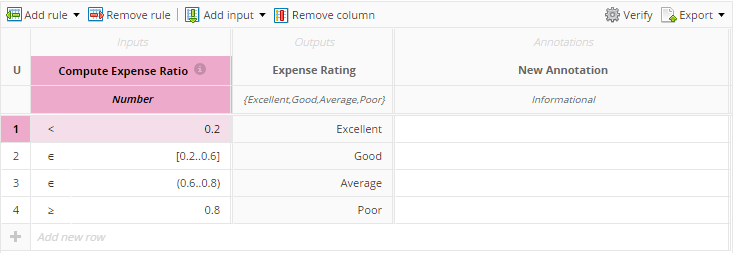
A decision model can be associated with, in business process management terms, a task activity. Decision models are associated with decision points in a task at which the process worker (or automated system) has to determine what the next process path should be or calculate the result of an activity. Take the process activity for approving a credit card application for example. There is typically a process activity associated with an approval or rejection decision (gateway), but at the same time you might also want to determine the interest rate in a consistent manner for all applicants. So the logic and associated calculations are all defined within a rules table contained within the decision model. Figure 1 illustrates an example rules table for determining an interest rate offered by a hypothetical credit card provider.
|
Rules Table Example: |
|
|
|
Figure 1 |
Q. What sorts of problems happen as a result of organizations’ creating silos around decision and process management?
There are many issues that can occur when processes and decision models are managed in silos. One key problem comes to light when looking at operational measures. Unless the organization looks holistically at both the process and the decisions involved, it’s difficult to pinpoint the root cause of performance. Whether it is because we made a good decision or because we have a good process may not be clear. Of course, if the performance result is less than what we expect, we need to understand if it was because the process wasn’t working the way we expected it to be or because the decisions weren’t ideal. This is where the key value proposition of integration comes in. Decision models, like process models, provide a manageable way of communicating, testing, and implementing the decision logic in a way that is commonly understood by all stakeholders.
Q. How can organizations break down these silos?
One of the ways to break down the silos is to have a common point of reference, which would not only include the process model definition but also the decision model definition. Integrating the two models onto the same system helps create a single source of truth for communicating information to the relevant stakeholders and understanding what changes will improve performance. Typically, senior management is very interested in reviewing how decisions are taken and how they can be managed. Just having the attention of senior managers can help address the silo issue.
For more information on this topic, check out the full interview, or for more process and performance management research and insights follow me on twitter at @hlykehogland or connect with me on Linkedin.