Number of T&E disbursements per "process expense reimbursements" FTE
This measure calculates the number of travel and entertainment (T&E) disbursements per full-time equivalent employee that performs the "process expense reimbursements" process, which consists of processing reimbursements to employees for the expenses incurred during the course of business. Activities include approving and processing advancements and reimbursements for employee expenses on the organization's behalf, capturing and reporting relevant tax data, and managing personal accounts. T&E expenditures are the reimbursable expenses employees incur on behalf of the company for example rental car, hotel, airfare, etc. This measure is part of a set of Staff Productivity measures that help companies assess the efficiency of their staff related to the process "process expense reimbursements".
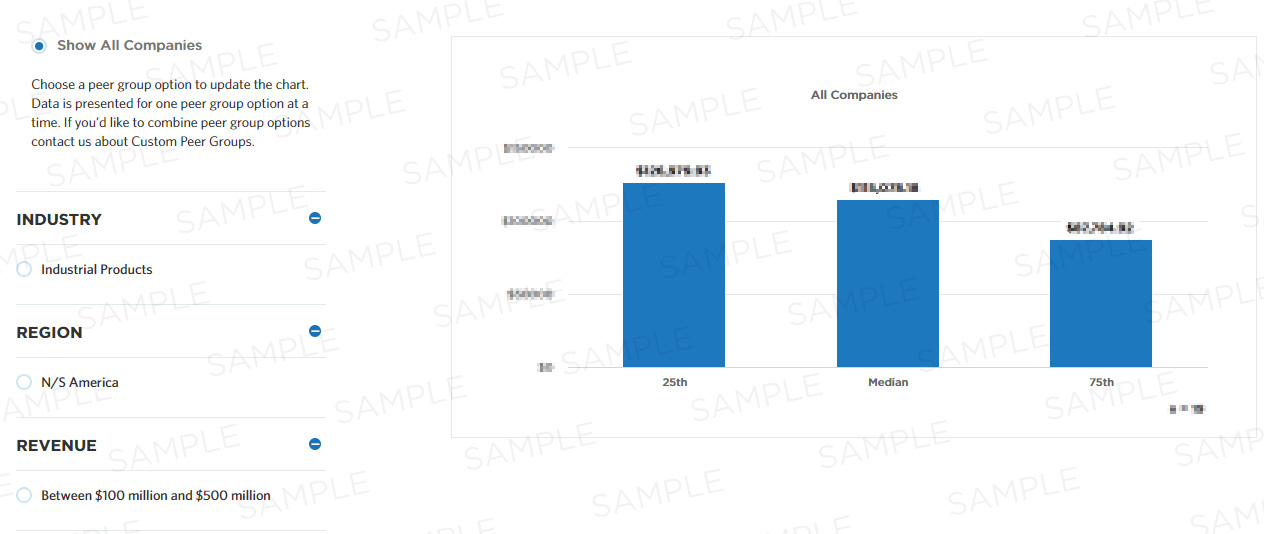
Benchmark Data
| 25th | Median | 75th |
|---|---|---|
| - | 7,500 | - |
Compute this Measure
Units for this measure are disbursements.
Number of T&E disbursements / Number of FTEs who perform the process "process expense reimbursements"
Key Terms
To calculate the number of full-time equivalents employed during the year for each respective process or activity, you must prorate the number of employees and the hours spent performing each process/activity. Assume that a full-time worker represents 40 hours per week. Provide the average number of full-time equivalents employed during the year for each respective process. Include full-time employees, part-time employees, and temporary workers hired during peak demand periods. Allocate only the portion of the employee's time that relates to or supports the activities identified for an applicable process. Prorate management and secretarial time by estimating the level of effort in support of each activity, by process.
For example, a part-time secretary in the finance department for XYZ, Inc. charges all of his time to finance department activities. He works 20 hours per week. The secretary splits his time evenly supporting employees working in the general accounting process and the financial reporting process. Thus, his time should be allocated by process. So, if he works throughout the year and supports these two processes, his time would be split evenly as:
20hrs/40hrs = .5FTE * 50% for general accounting = .25FTE for general accounting
20hrs/40hrs = .5FTE * 50% for financial reporting = .25FTE for financial reporting
Processing of advancements and reimbursements for employee expenses on the organization's behalf. This process often dovetails with the processing of accounts payable. This process also includes development and use of policies and procedures.
T&E expenditures are the reimbursable expenses an employee incurs on behalf of the company (e.g., rental car, hotel, airfare).
To calculate the number of full-time equivalents employed during the year for each respective process or activity, you must prorate the number of employees and the hours spent performing each process/activity. Assume that a full-time worker represents 40 hours per week. Provide the average number of full-time equivalents employed during the year for each respective process. Include full-time employees, part-time employees, and temporary workers hired during peak demand periods. Allocate only the portion of the employee's time that relates to or supports the activities identified for an applicable process. Prorate management and secretarial time by estimating the level of effort in support of each activity, by process.
For example, a part-time secretary in the finance department for XYZ, Inc. charges all of his time to finance department activities. He works 20 hours per week. The secretary splits his time evenly supporting employees working in the general accounting process and the financial reporting process. Thus, his time should be allocated by process. So, if he works throughout the year and supports these two processes, his time would be split evenly as:
20hrs/40hrs = .5FTE * 50% for general accounting = .25FTE for general accounting
20hrs/40hrs = .5FTE * 50% for financial reporting = .25FTE for financial reporting
Staff Productivity is a measure of the efficiency of individuals performing specific processes. Measures in staff productivity generally relate the transaction volume or outcome of the process with the effort in terms of full time equivalent employees to perform the process.
The metric value which represents the 50th percentile of a peer group. This could also be communicated as the metric value where half of the peer group sample shows lower performance than the expressed metric value or half of the peer group sample shows higher performance than the expressed metric value.