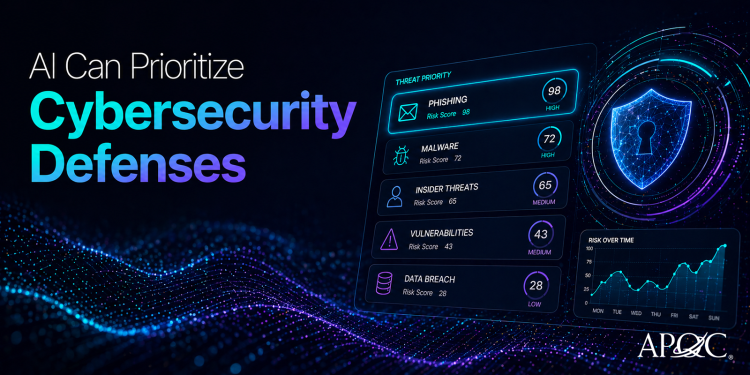
Artificial intelligence (AI) has created a paradigm shift for Cybersecurity. AI and machine learning (ML)-powered computing systems are now essential to cyber operations. They assist security teams in keeping an eye on large networks, spotting irregularities instantly, and reacting more quickly than is humanly feasible. By automating tasks that would otherwise overburden under-resourced teams, AI levels the playing field in today's threat landscape, which is characterized by sophisticated ransomware, social engineering, and malware.
I examine how these developments are changing our digital environment in my book, Inside Cyber: How AI, 5G, IoT, and Quantum Computing Will Transform Privacy and Our Security.
Artificial intelligence stands out as a potent new weapon for attackers as well as a strong enabler of defense. Understanding AI's twin effects is now crucial for companies of all sizes to survive in a time of hyperconnected threats.
AI Can Prioritize Cybersecurity Defenses
Threat intelligence, network surveillance, and automated reaction all benefit greatly from AI's superior ability to prioritize and act upon data. Based on my analysis, it helps in the following ways:
- Threat and anomaly detection in real-time identification: Before conventional tools can respond, AI searches data and files to identify anomalous activity, such as malicious credentials, brute-force login attempts, strange data transfers, or exfiltration. It evaluates hazards and vulnerabilities by correlating data across silos.
- Predictive analytics and network monitoring: AI allows for real-time reporting on deviations and horizon scanning. Descriptive analytics (what happened?), diagnostic analytics (why and how?), predictive analytics (possible effects of vulnerabilities), and prescriptive analytics (suggested containment steps) are all supported.
- Automation and security orchestration: AI is used by programs like Security Orchestration, Automation, and Response (SOAR) to handle enormous data quantities, coordinate incident response, and interface with firewalls, endpoints, and antivirus layers. This is particularly important for cloud, IoT, and 5G contexts.
- Improved forensics and decision-making: AI minimizes noise, prioritizes warnings, and closes talent gaps in security operations centers (SOCs) by categorizing and integrating data.
The future of cybersecurity lies in AI and ML. In order to safeguard crucial infrastructure, supply chains, and business continuity, it transforms reactive defenses into proactive, adaptable barriers.
The Two-Sided Sword: How Criminals Use AI as a Weapon
Threat actors, criminal organizations, and opportunistic hackers are adopting AI more quickly than many businesses, proving that AI is not just a defender's ally. Convincing deepfakes, voice cloning for CEO fraud, and massively customized phishing are all made possible by generative AI. Malicious AI has the ability to produce self-modifying malware that conducts adaptive attacks, avoids detection, and learns from mistakes.
AI is already being used by cybercriminals for automated exploitation, reconnaissance, and hiding payloads in trustworthy software. Small and mid-sized firms (SMBs), healthcare organizations, and others without substantial investments in defensive AI are the most vulnerable, as I mentioned in my C-suite primer. There is an obvious asymmetry: defenders must always succeed, whereas attackers only need to succeed once.
AI is beneficial to both parties. Companies that use AI recklessly run the risk of creating new systemic risks, while those who use it carefully gain a significant advantage.
Cybersecurity Action Plan for Organizations:
The cybersecurity ramifications of AI cannot be disregarded by any enterprise. Based on my published observations and consulting expertise, the following is a succinct action plan:
- Use tools enhanced by AI proactively: Make investments in systems that provide SOAR capabilities, automated threat hunting, and real-time anomaly detection. Give top priority to cloud, endpoint, and Internet of Things solutions that work with your current stack.
- Create an AI risk framework: Consider AI as both a strength and a weakness. Establish protocols for secure AI development and deployment, governance, and testing of hostile AI assaults.
- Fill the talent and resource gap: Increase staffing levels with AI. Managed security service providers (MSSPs) that offer AI-driven SOC capabilities without incurring complete internal costs should be taken into consideration by SMBs.
- Layer defenses with zero trust and defense-in-depth: Prepare for dangers from the quantum era by combining AI with fundamental controls like encryption, multi-factor authentication, frequent patching, and isolated backups.
- Encourage cooperation and awareness: Regularly use AI situations in tabletop exercises. Participate in public-private collaborations and use tools like my operational cybersecurity models. Risk management needs to change at the same rate as algorithms. Businesses will gain more resilience and a competitive edge if they adopt AI defensively while reducing its offensive potential.
Now is the moment to incorporate AI fluency into your cybersecurity plan. Both the dangers and the countermeasures are changing at an exponential rate. Preparing ahead of time will protect your business, clients, and future.