
Business process automation looks at automation for the enterprise. Sometimes referred to as simply process automation, it refers to the use of software to mimic human action and connect multiple fragmented systems together through automation.
Process automation enables systems to carry out high-volume, multistep actions without manual intervention by employees, to capture information, manipulate data, or trigger responses in other systems.
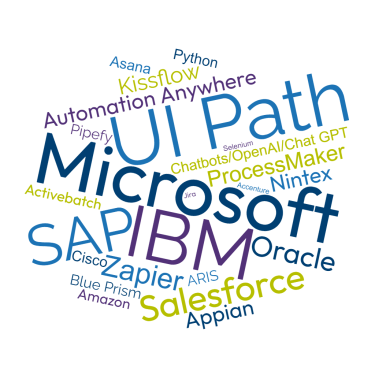
According to our survey, 84% of organizations feel that automation makes their processes more efficient, and organizations note leveraging tools such as Microsoft, IBM, UI Path, SAP, Salesforce, among others seen in the word cloud below to aid in their automation efforts.
Where to Focus Business Automation Efforts
Due to limited time and resources, most organizations must pick a place to focus their automation efforts first. APQC also suggests ensuring you start small and align the pilot function with a business need and/or strategic initiative. When deciding where to focus automation efforts, organizations reported focusing on these top five functions:
- Process management (47%)
- Finance (46%)
- Customer service (41%)
- Supply chain management (36%)
- Sales (35%)
The data above is from our 2024 survey. We ran a similar survey in 2018 and organizations were also focused on finance, process management, and customer service; however, knowledge and information management (KM) and human resources (HR) were the number four and five spots respectively. In 2024 those functions moved down to the number six (KM) and eight (HR) spots.
Throughout the past few years, supply chain management has been in the spotlight with the increased amount of e-commerce sales, product shortages, and more; so, this replacing the number four slot makes total sense to me. While KM did drop a bit more than I’d expect, I think process and knowledge teams are working better today than they have in the past and realizing they work better together than they do apart.
Regardless of where organizations focus their efforts, they most often realize the following benefits:
- Streamlined/simplified processes (44%)
- Cost savings (36%)
- Better quality (34%)
- Data management improvement (34%)
- Better decision making (31%)
Learn more about our recent digital tools and technologies in our content collection, Digital and Its Role in Process.