Earlier this week, I 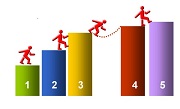 received a question through APQC’s Ask Us service from a member who wanted to read more about organizations that have achieved level 4 or 5 on APQC’s Levels of Knowledge Management Maturity scale. I get asked this question at least a few times every month, so I thought it would make sense to share some resources and examples here.
(First, a little background: For anyone unfamiliar with APQC's Levels of Knowledge Management Maturity, it’s a five-stage maturity model designed to help organizations determine the degree of sophistication of their KM programs and the ROI from their KM efforts. APQC members can use APQC’s KM Capability Assessment Tool to find out their current KM maturity level and any gaps preventing them from progressing.)
When organizations are assessing their own maturity, it’s natural to want to know: Who’s got this KM thing all locked up? What does a Level 5 KM program look like, and who has one? This can be tricky to answer since confidentiality prevents us from sharing any specific organization’s assessment results. However, we do feature case studies and examples from mature KM programs throughout our research. Here’s my quick-and-dirty reading list to get smart about what a mature KM program might look like:
- KM at Alcoa World Alumina
- KM at ConocoPhillips and How ConocoPhillips Embraces and Cultivates Diverse, Empowered Communities*
- Knowledge Management at Fluor and Developing Experts at Fluor*
- Knowledge Management at U.S. Army ARDEC
- Using Knowledge Management to Develop Technical Talent at Schlumberger Ltd.*
- Developing a Road Map to KM Maturity Level 5
(* items are open to nonmembers)
Right now, we’re knee-deep in research to provide better answers to questions about the maturity model. Part of this involves number-crunching data from 200+ assessments to see what it tells us about how maturity progresses and the key elements to boost organizations to the next level. We’re also interviewing organizations that have assessed their KM maturity in order to understand how those KM programs have used the assessment process and results to spur KM investment and improvement.
Has your organization assessed its KM maturity to establish a baseline or measure progress? Did you find it valuable—or not? Is your organization using APQC’s Levels of Maturity, or do you prefer a different maturity model?
Please post ideas, opinions, or research questions you’d like us to cover in the comments below. If you’d like to be interviewed for this project, you can Tweet me @ltrees_km or contact me directly at [email protected]. For the rest of you: Look for the results of this research to be released this fall.