
Have you noticed? Over the last few years, workplace mentoring has become a hot topic. In APQC survey results, your AskUs questions, and conversations with members, we’ve heard that organizations today want and need mentoring. But why? Mentoring is not a new organizational tool. In thinking about this question, my conclusion is that mentoring uniquely addresses a number of present-day workplace realities.
Current Workplace Realities Are Uniquely Addressed by Mentoring
- Many generations are in the workplace today and learning to work together.
- The large Baby Boomer generation is retiring and their know-how must be transferred.
- Top reasons for employee turnover today are lack of development and advancement.
- HR budget and staffing cuts are limiting how much formal training employers can provide.
- Lean staffing is making it a challenge for managers to give employees time to learn.
- Employees are switching jobs frequently, increasing organizational demand for onboarding.
While interest in mentoring has spread far and wide, experience with successful mentoring programs and relationships is less common. Many of have been searching for answers to questions about mentoring.
Employers and Employees Have Many Questions about Mentoring
- What are the key attributes of a successful mentoring program?
- What should be avoided when designing a mentoring program?
- How do you teach someone to be a mentor?
- How do you keep mentors and mentee pairs engaged in the mentoring process?
- How do you ensure mentees learn from the mentoring experience?
Mentoring Life Cycle Has Answers, Shows How Mentoring Can Meet Workplace Needs
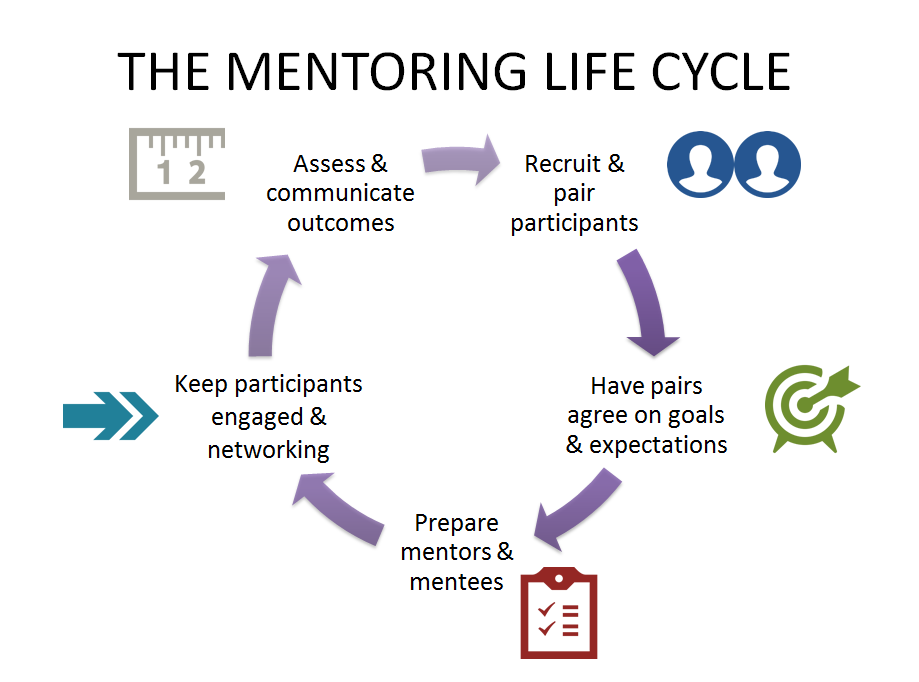
APQC conducted research to answer these and other questions about mentoring. We gleaned tips and best practices from many organizations that have successful mentoring programs. We’ve organized these recommendations into a mentoring life cycle that employers and employees can follow.
- The mentoring life cycle starts with selecting participants—both mentors and mentees—and pairing them up.
- Then, it moves to the kickoff of the mentorship, where the partners work together to set goals and expectations.
- There is training that mentors and mentees need to successfully engage with one another.
- And, there are steps that can be taken to keep mentoring pairs engaged and on track over the course of the mentorship.
How You Can Learn More
Lauren Trees and I will be presenting “Mentoring as a Catalyst for Knowledge Transfer and Network Building” at APQC’s 2016 KM Conference April 28-29.
In addition, APQC’s Workplace Mentoring best practices report explains the mentoring life cycle stages in detail. It includes 14 best practices spanning the end-to-end mentoring process, from selecting the right candidates to measuring and communicating outcomes. These are supported by detailed examples from seven organizations in the aerospace, chemicals, healthcare, government, military, and natural resource extraction industries. APQC members can download the full report for free. Nonmembers can use the discount code MENTOR to receive a 50% discount through May 31.
Want more? Case studies of the 7 featured organizations are available in the Workplace Mentoring for Technical and Nontechnical Audiences Collection.
- Cardinal Health Inc.
- GovLoop Government Social Media and Knowledge Network
- A Natural Resource Company
- Praxair Inc.
- The University of Texas MD Anderson Cancer Center
- U.S. Army Armament Research, Development and Engineering Center (ARDEC)
No matter what you want to achieve with your mentoring program or what level of resources you can devote, there’s something in this research that can help you.