Driving a Rover on Mars? Touring Valen's Reef in the Bird’s Head Seascape international preserve? Reliving Hurricane Sandy as the waters rose? I had a chance to experience all three of these in virtual reality (VR) at the 2016 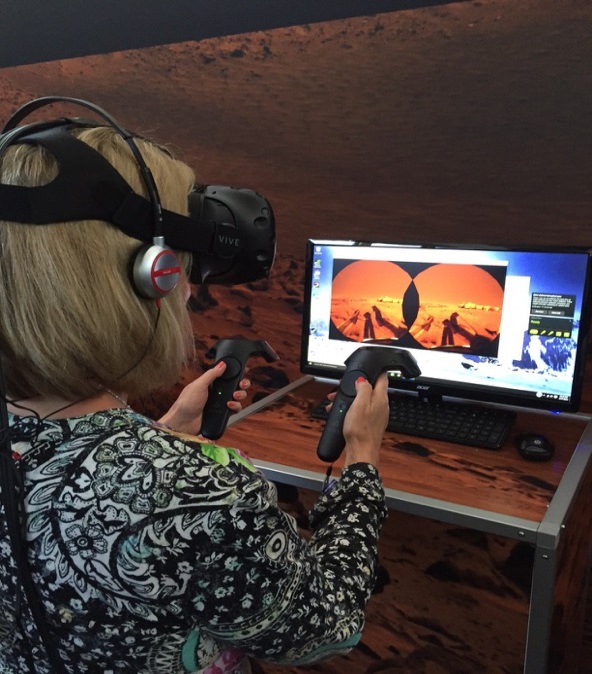 Aspen Ideas Festival.
All three experiences would have been more fun if I had been able to interact and share the experience with other people. On Mars, I kept wanting to interact with the android robot a few “feet” away. While diving on the reef, I yearned to turn to the person sitting next to me at the real-world table to exclaim about the beauty and diversity in Bird’s Head. We were both seeing it – but she was also hidden and alone in her own little head-set world.
See Photo at Right: Carla is driving the Mars Rover. Imagine how antiquated these headsets will seem in 10 years. Remember when mobile phones were the size of a loaf of bread?
Immersive technologies are seductive. There is a reason the wildly popular Pokemon Go app launches with the warning “Remember to be alert at all times. Be aware of  your environment.” (It won’t be long before there is a syndrome coined for ER visits for injuries while one’s face is buried in a mobile device.)
Social isolation is the biggest risk with any immersive technology. At least in gaming and simulated worlds you can interact with other players as avatars. This is not yet possible with VR. Until you can have a shared experience in virtual space, it won’t be a substitute for the real thing.
The potential of VR is enormous: for chronicling disasters, taking experts and tourists to places they might never go, health care diagnosis and treatment, etc. But it will be far better when it is social (and the headsets are less dorky).