(The first of a three-part series on lessons from the sharing economy for the way we work.)
Airbnb's Workspace of the Future
Last week, I was treated to an inside look at the headquarters of Airbnb—an icon of the new sharing economy. The home-sharing Internet behemoth has hosts and rentals in 192 countries and website bookings surpassing one million a night at its peak. Situated in SoMa, the ultra-hip warehouse district in San Francisco, Airbnb has transformed its headquarters into a microcosm of its "product" as well as a laid back setting for its 20-something employees. In homage to the hosts that make Airbnb possible, it has recreated exact replicas of some of its coolest rental properties, now used for workspaces and meeting rooms for Airbnb’s web developers, analysts, marketers, and machine-learning wunderkinds.
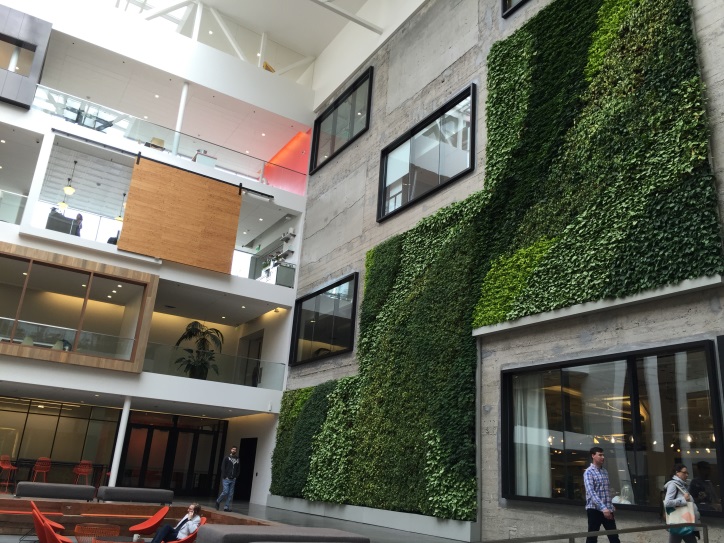 Each replica is delightful in the way a very expensive dollhouse is fun: "Look, honey. They made it look like the real thing. How cute is that?!" What makes their corporate digs even more interesting is that it provides open spaces and mobility allowing employees to work anywhere and enjoy the possibility of serendipity. The photo to the right is Airbnb's atrium that houses one of the largest living walls in California.
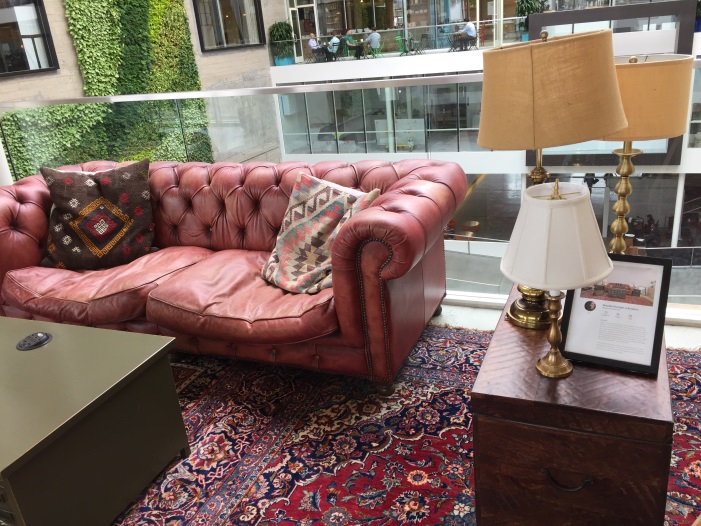
Work spaces were open, casual, and seemed unassigned and mobile (although there were clusters of marketing, engineers/developers, etc.). The staff I met was genuinely warm and welcoming. The photo below is an example of an Airbnb meeting space.
 Chip Conley, Airbnb's global head of hospitality and strategy, was my host for this behind-the-scenes glimpse of the brick and mortar incarnation of the new Internet peer-to-peer sharing economy. (More about Chip's various incarnations as a disruptor of the hospitality industry in the second part of this series.)
Airbnb has grown from a hypothetical valuation of $2.5 billion dollars when Chip Conley joined three years ago to more than $25 billion in Internet dollars today.
What fuels this kind of growth? Trust, analytics, and excess capacity.
Trust Is the Currency of the Sharing Economy
The peer-to-peer sharing economy is fueled by Internet users' growing comfort interacting and transacting with strangers, along with excess capacity and the snowballing sophistication of apps and analytics. (Take note corporate community managers: These same Internet users bring that level of digital comfort to their workspace and corporate communities.)
Along with Über, the ride-sharing phenom whose app-guided driver shuttled me over to my chic destination, Airbnb arose from the ashes of the 2008 financial meltdown. While Über has an uncomfortable whiff of profiting from the underemployment of so many after the financial collapse, Airbnb is more like your hip cousin or aunt offering you the use of an extra bedroom or their vacation house. In both cases, matches are made, money changes hands, and underutilized assets are put to work.
However, the magic that produces trust is deeper. Trust is the currency but analytics enable the market.
*Rachel Botsmann's TED talk on the subject is excellent.
Analytics Enable the New Economy
Every economy depends ultimately on trust to work, but in the peer-to-peer sharing economy the analysts are the engineers of trust. What fuels the trust are the peer-to-peer ratings. The brew of algorithms concocted by analysts to detect wrong-doers (e.g., those who cancel or no-show or worse) and reward the super-hosts and super drivers works. Rather than credit agencies such as Experian deciding who is worth a risk, your peers do by their ratings validated by the analysts.
Airbnb’s business model is a perfect example: it is predicated on trust fueled by powerful analytics applied to peer ratings and usage. The rating system reassures hosts and potential guests that their choices are “safe;” safety being a central issue when letting someone into your home or guesting in some else’s. (While Netflix and Amazon have impressive systems driving ratings and recommendations, it is Airbnb and Uber who epitomize the physical trust that must be present for face-to-face matches to be made. Too bad many dating sites don’t provide the same kind of scrutiny.)
I confess to being wide-eyed at the finesse of the analytics and algorithms that make Airbnb and Über possible. Über drivers share my wonder: as soon as they pick me up, they are often eager to tell me what new whiz-bang things the Über app can do. Likewise, Airbnb analysts are constantly tweaking their machine-learning algorithms to optimize host matches and the user website experience. Testimonials to their alchemy abound.
I came away from my Airbnb visit with the sense that the workspace of the future is now. Trust, transparency, personal accountability, findability, peer-to-peer ratings, big data and analytics, excess capacity, and mobility have converged and created a new kind of market.
The challenge for companies and knowledge management and community leaders is to create the same digital peer-to-peer-sharing marketplace and sense of engagement for their increasingly virtual workspaces. As cloud-based programs become more affordable, analytics will help.
Through the Looking Glass
 Which finally brings me to Alice and Through the Looking Glass. (Dear Reader: Queue up Fleetwood Mac's White Rabbit on your favorite music device. It will enhance your reading experience.)
On my Über ride to Airbnb, we passed by the offices of Pinterest, Eventbrite, and Slack, the instant messaging service. It felt a bit unreal, as if I had fallen through my iPhone screen into Internet space, much as it may have felt to Alice when she fell through the looking glass into Wonderland.
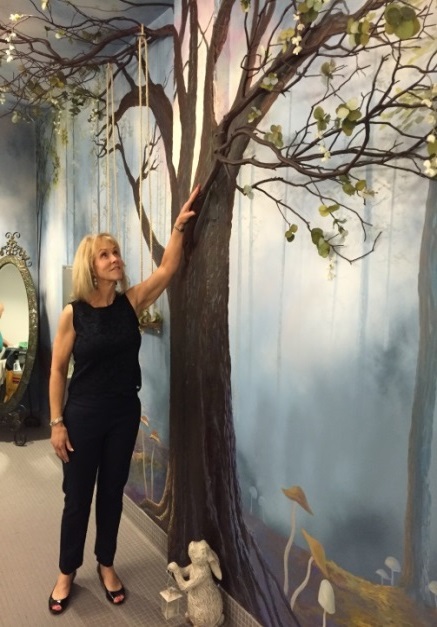
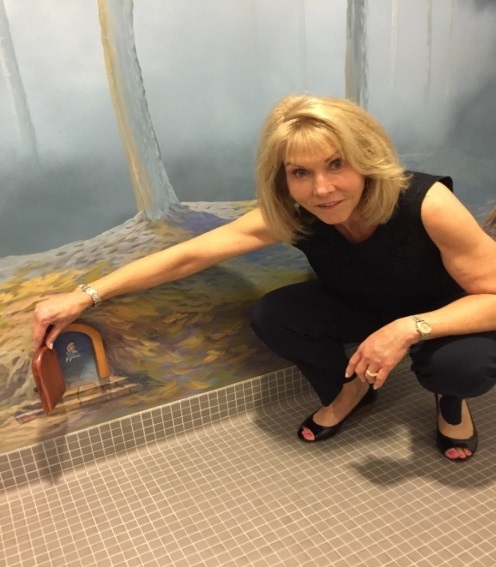 Upon reflection, it shouldn’t have been surprising to find these Internet inhabitants also in The Real World: after all, their analysts have to sit somewhere. Why stay at home when the food and perks are way better at the "office?” And as further testament to the engagement model at Airbnb, witness the women's bathroom on the third floor. It was designed and furnished by employees with the theme of Alice in Wonderland, complete with the White Rabbit and a tiny Alice behind an itty-bitty door.
I guess even the 20-something employees share my wonder at the magical transformation of the new economy. Are your workspaces an homage to your customers and a playground for creative employees?
Check out the rest of my Big Thinkers, Big Ideas interviews on APQC’s Knowledge Base.
Subscribe to the Big Thinkers, Big Ideas podcast on Itunes or on APQCPodcasts on Podbean.
You can connect with me on Twitter @odell_carla