
As businesses navigate and handle the ups and downs of a changing economy, finance professionals are under pressure to drive transformation, manage cash flow and balance risk. Based on our recent insights from APQC’s 2025 Financial Management Priorities and Challenges survey, here are the key trends, challenges, and actionable strategies shaping the finance function in 2025.
1. The Age of Digital Transformation in Finance
With 72% of organizations prioritizing digital financial planning and budgeting, 2025 is shaping up to be the year finance functions fully embrace technology. Tools like enterprise resource planning (ERP) systems, AI-driven analytics, and robotic process automation are helping organizations reduce manual processes and improve data accuracy.
Digital Transformation Initiatives
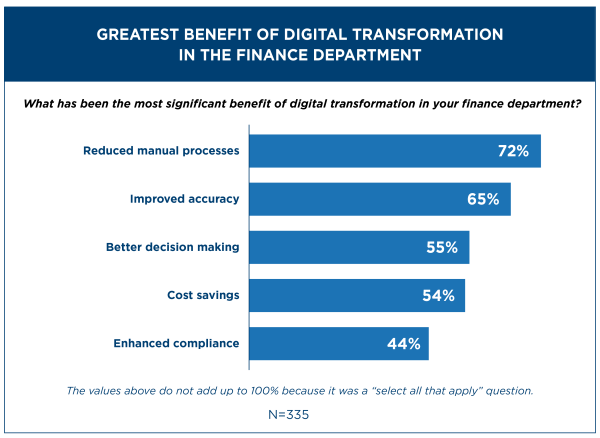
Why It Matters: Digital transformation not only enhances efficiency but also enables finance teams to focus on strategic initiatives. For example, AI-powered analytics can uncover trends in massive data sets, offering insights into better decision-making and fraud detection.
2. Cash Flow Management: The Lifeblood of Business
Cash flow remains a critical focus area, with organizations citing delayed customer payments, inaccurate forecasting, and inflation as top challenges. Strategies like frequent cash flow reviews and automated invoicing systems are helping finance teams maintain liquidity. For strategies on minimizing late payments, see Get Paid on Time: 5 Strategies to Minimize Late Customer Payments.
Why It Matters: Effective cash flow management ensures that businesses can meet short-term obligations and invest in growth opportunities.
3. Data Analytics: Turning Numbers into Insights
Nearly all respondents reported leveraging analytics for key financial processes, with 69% using analytics for accurate forecasting and 80% to track key performance indicators. Transitioning from manual spreadsheets to automated data visualization platforms enables companies to gain real-time insights, improve data accuracy, enhance decision-making and scale analytics efficiently while reducing manual effort and errors. For more information see our article Three Tips for More Effective Finance Data Visualization.
Why It Matters: Real-time analytics help organizations stay ahead of market trends and detect risks, from fraud to operational inefficiencies.
4. Proactive Risk Management in Uncertain Times
From market volatility to cyber threats, risk management remains a top priority. Organizations are increasingly adopting comprehensive risk frameworks and advanced tools like integrated risk management software.
Why It Matters: Proactive risk management builds resilience, enabling organizations to respond swiftly to disruptions while maintaining operational stability.
Seize the Opportunity in 2025
The finance function is no longer just about managing the numbers. In 2025, finance leaders can act as strategic partners, using technology and data to drive innovation and resilience. By focusing on digital transformation, cash flow, data analytics, and risk management, organizations can position themselves for success in an unpredictable future.